
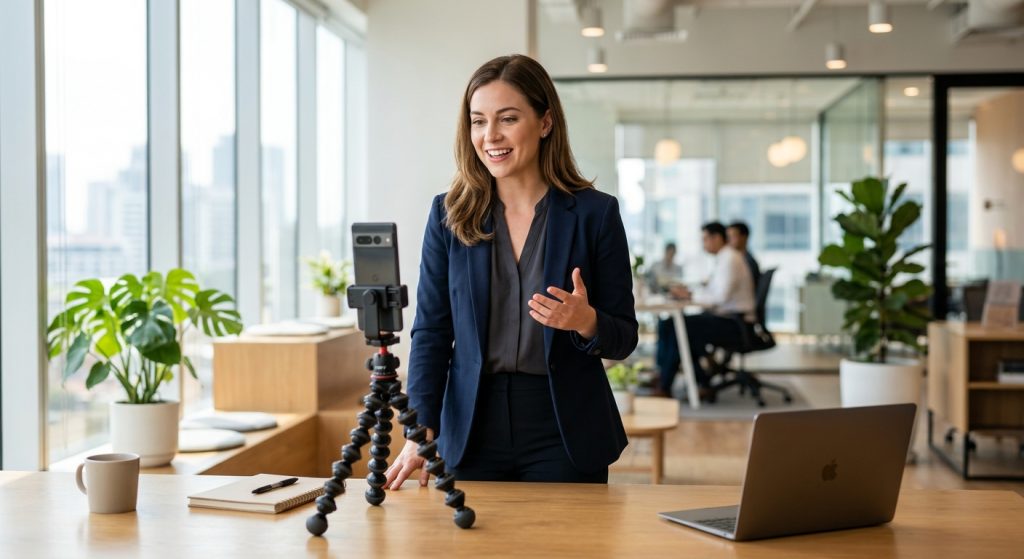
Most cold emails die in the preview pane. A prospect sees a name they don’t know, a subject line they’ve seen forty times this week, and the delete key does the rest. Video prospecting is the fix a lot of sales teams reach for: instead of another paragraph, you send a short video of a real person talking directly to one specific buyer. Done well, it gets opened. Done badly, it gets opened once and remembered for the wrong reasons.
I’ve spent years behind cameras making sales and marketing video for businesses, and the pattern is consistent. The videos that work aren’t the slickest. They’re the most specific. Here’s how to build a video prospecting program that earns replies, and where it makes sense to bring in a production crew instead of a webcam.
What Is Video Prospecting and Why Does It Beat a Cold Email?
Video prospecting is the practice of sending a short, personalized video, usually 30 to 90 seconds, to a named prospect in place of or alongside a text-only outreach message. It works because a face and a voice build trust faster than text, and because almost nobody else in the inbox is doing it.
The numbers back it up. Sendspark’s 2026 B2B video prospecting guide puts typical text-email reply rates at 1-3%, generic video at 3-5%, and personalized video at 6-15%. That’s a benchmark from a vendor that sells the software, so treat the top end as a ceiling, not a promise. But even the low end of that range roughly doubles what a plain email does.
The reason isn’t magic. A video proves a human spent time on this. When you reference the prospect’s own website, a recent hire, or a product launch on screen, you’ve shown work that a template can’t fake.
How Long Should a Video Prospecting Message Be?
Keep a cold prospecting video between 30 and 75 seconds. Past 90 seconds, watch-through drops sharply, and the prospect hasn’t agreed to give you any time yet.
A structure that holds up in practice:
- Seconds 0-5: Their name and the reason you’re recording. “Dana, I saw your team just opened the Henderson location.”
- Seconds 5-25: The one problem you think they have, stated plainly.
- Seconds 25-50: How you’ve solved it for someone similar, with a number if you have one.
- Last 10 seconds: One ask. A 15-minute call, not a demo, not a proposal.
One call to action. Every extra link or option gives the prospect a reason to do nothing.
What Makes a Prospecting Video Worth Replying To?

A prospecting video earns a reply when it shows evidence of research and makes a single, easy ask. Everything else, including the lighting, is secondary to that.
The strongest personalization is visual. Screen-share their homepage, a job posting, or a Google Business listing and point at the thing you’re talking about. Reps who just say “I loved your recent post” sound like everyone else. Reps who show the post, and say what it made them think about, don’t.
Pick a trigger before you hit record: a new hire, a funding round, an expansion, a bad review, a competitor move. Tools like LinkedIn Sales Navigator surface these, and a trigger gives your first sentence a reason to exist.
Two small details move opens. Put your face in the thumbnail, since face thumbnails get watched noticeably more than a blank frame. And put the word “video” in the subject line, or something curiosity-driven, so the prospect knows what they’re clicking.
When Should You Use a Phone, and When Should You Hire a Crew?
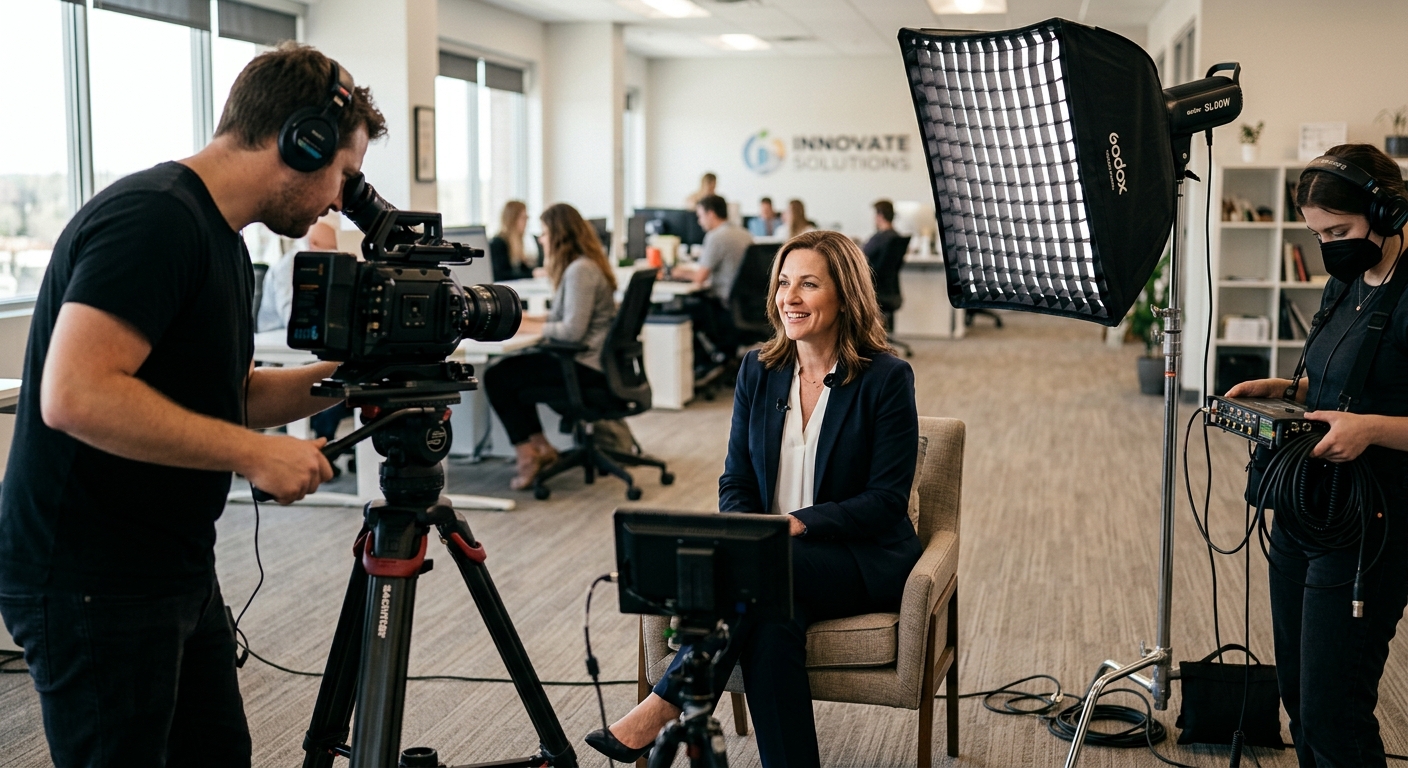
Record one-to-one prospecting videos yourself on a phone or webcam, and hire a production crew for the assets that get reused: the proof, the brand intro, and the case studies you link inside those messages.
A rep recording a 45-second note to one prospect should not need a lighting kit. Good window light, a quiet room, and a decent lavalier mic are enough. Audio matters more than picture here; people forgive a soft image and abandon a muddy voice, which is why our notes on sound for video production apply even to a phone setup.
Where a professional shoot pays off is the material your prospecting leans on. A customer story that a prospect can watch after your message lands carries more weight than anything you can say about yourself, and that’s the job of testimonial videos that convert. A polished 60-90 second brand or product piece, the kind covered in our guide to how to create a promo video, gives the prospect somewhere to go when your note makes them curious.
If you’re building that library, a full-service video production team can shoot a day of testimonials, product footage, and founder messages that your sales team will draw from for a year. For businesses in the Southwest, our Las Vegas video production crew handles exactly this kind of multi-asset sales library, from interviews to b-roll.
Where Does Video Prospecting Fit in a Sequence?
Video works best as the second or third touch in a multichannel sequence, not as the cold opener to a list of thousands. A first email earns a little context, and the video then arrives as a more personal follow-up.
A cadence that holds up:
1. Day 1: A short, value-focused email or LinkedIn connection note.
2. Day 3: The personalized video, sent by email or as a native LinkedIn video message.
3. Day 6: A case study or customer video, the kind produced for your marketing video library.
4. Day 10: A brief, polite close-out message.
Account-based teams get the most from this. If you’re pursuing 30 target accounts, recording 30 genuinely custom videos is a few hours of work. If you’re pursuing 3,000, you’re in AI-personalization territory, and the quality bar changes: dynamic-background tools can scale a master recording, but the prospect can tell when no human watched their site.
What Mistakes Kill Video Prospecting Campaigns?
The most common failure is a video that is really a pitch deck read aloud. Prospects stop watching when the first ten seconds are about you.
Other repeat offenders: a generic “Hi there” opener, a ten-minute product tour, a background full of clutter, no captions for people who watch on mute, and no follow-up. Add captions every time. A large share of business video is watched without sound, and an auto-transcribed caption track costs you two minutes.
Don’t send video to someone who hasn’t been researched. The format raises the cost of a bad message, because a prospect who clicks and finds a template feels misled.
How Do You Measure Video Prospecting?
Track four numbers: open rate, play rate, watch-through rate, and reply or meeting-booked rate. Reply rate is the one that matters, but the first three tell you which part of the message is broken.
If opens are strong and plays are weak, your thumbnail or subject line is underperforming. If plays are strong and watch-through is weak, the video is too long or the first 15 seconds don’t deliver. If everything is fine but replies are flat, your ask is the problem. Compare against your own text-only control group for a month before judging the program, and log meetings booked rather than views, since views are easy to inflate.
Prospecting video won’t rescue a weak offer or a bad list. But for teams that already have a real product and a clear buyer, it’s one of the few outbound tactics that still feels like a person reached out. Build the personalized layer in-house, put real production budget behind the proof that supports it, and the two together do far more than either alone.
Frequently Asked Questions
What is video prospecting?
Video prospecting is the practice of sending a short, personalized video, typically 30 to 90 seconds, to a specific sales prospect instead of or alongside a text-only email or message. The video shows a real person addressing the prospect by name and referencing their business, which builds trust faster than text.
How long should a video prospecting message be?
A cold video prospecting message should run 30 to 75 seconds. Completion rates fall noticeably after about 90 seconds, so state the prospect’s name, their likely problem, one proof point, and a single call to action, then stop.
Does video prospecting actually increase reply rates?
Yes, generally. Sendspark’s 2026 B2B guide benchmarks text-email replies at 1-3% versus 6-15% for personalized video, though vendor figures run optimistic. Results depend heavily on list quality, how specific the personalization is, and whether the offer fits the prospect.
Do I need a professional crew to record prospecting videos?
No. One-to-one prospecting videos can be recorded on a phone or webcam with window light and a clip-on microphone. Professional production earns its cost on reusable assets such as customer testimonials, case studies, and brand videos that prospects watch after your message.
When in a sales sequence should I send a prospecting video?
Send the video as the second or third touch, roughly day 3 of a 10-day sequence, after a short first email or LinkedIn note. This gives the prospect context first and makes the video feel like a personal follow-up rather than a cold interruption.
