
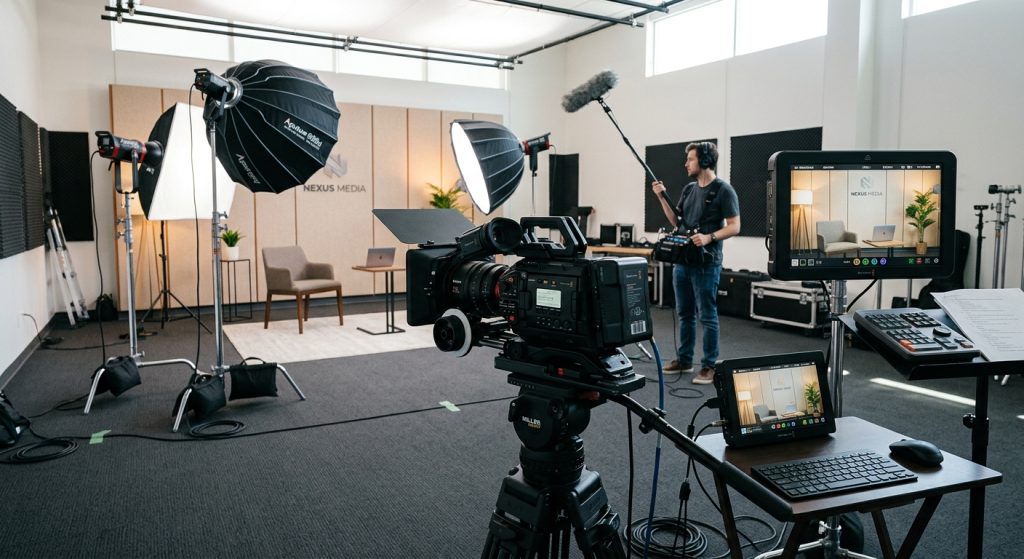
Your first shoot without the right gear teaches you more than any equipment review. A business owner hands you a vision, you spend two days making it real, and by wrap you know exactly what you wish you’d brought. This guide skips that tuition. Here is a working essential video production equipment list — organized the way professional crews actually think about it, not the way gear reviews present it.
The Essential Video Production Equipment List at a Glance
Professional crews organize their kit across six categories: cameras and lenses, audio capture, lighting, support gear, power and monitoring, and post-production tools. Skipping any category doesn’t save money — it shifts the cost to the edit bay or to a reshoot. Clients who’ve worked with us through our video production services know this list reflects what we carry on a real South Bay commercial shoot, not a fantasy spec sheet.
Cameras: Your Image Capture Engine
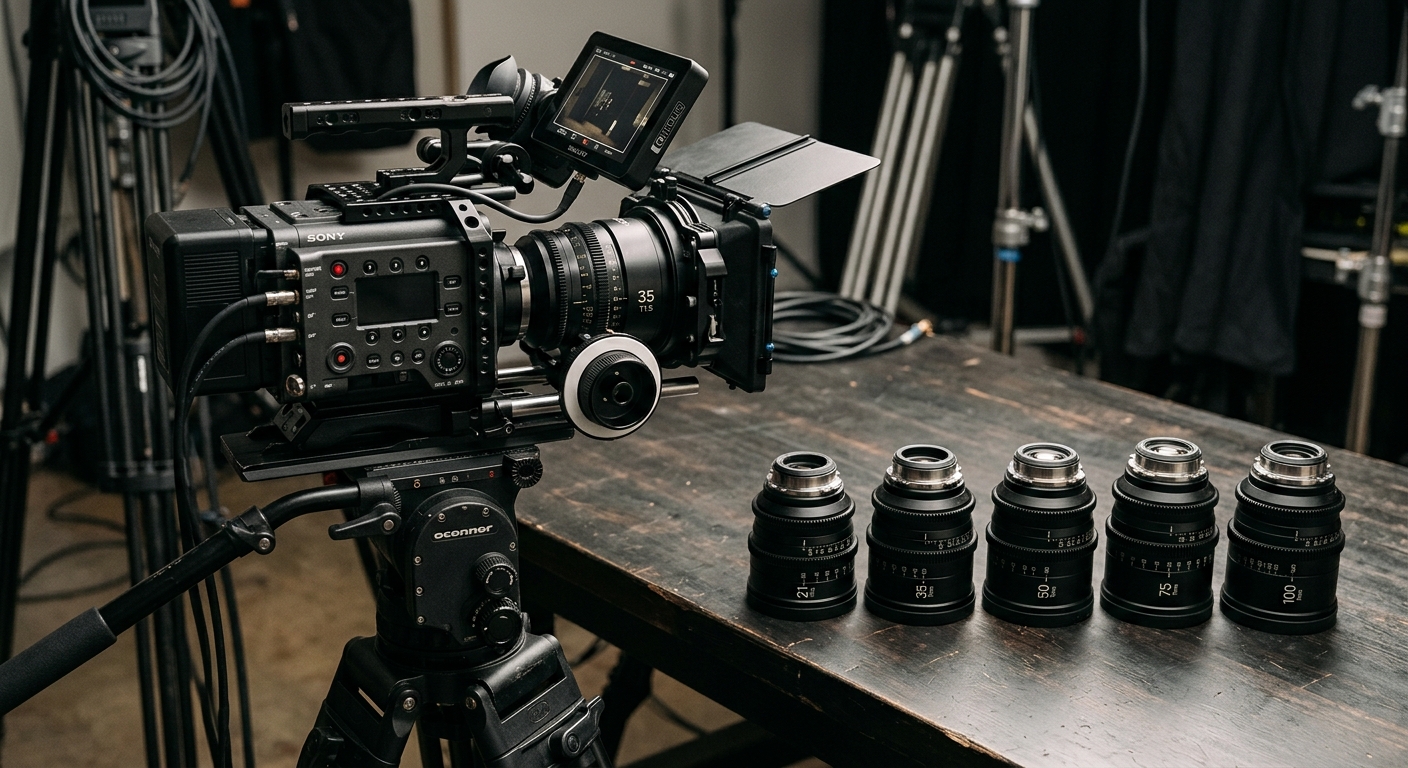
The camera isn’t the most important piece of gear on set — but it’s the one every client asks about first. For corporate and commercial work, most professional crews shoot on cinema cameras or mirrorless hybrids with large sensors: Sony FX3, Sony FX6, ARRI Alexa Mini LF, RED Monstro. The choice depends on budget, post-production pipeline, and the look the client needs.
Sensor size and dynamic range matter more than brand name. A larger sensor handles low-light better and produces the shallow depth-of-field that separates produced video from footage shot on a phone. For 4K delivery, most cameras in the $3,000–$15,000 range perform well. Broadcast and feature work pushes the specs higher.
Always budget for a second camera body on any shoot longer than a single day. A backup rental is trivial in cost compared to losing a full production day to a malfunction.
If you’re building a first kit rather than hiring a full crew, our breakdown of DSLR video production gear covers camera selection at the entry and mid-level in practical terms.
Lenses: Where the Look Actually Comes From
Most cinematographers will tell you: spend more on glass than on the body. Lenses shape the image — compression, bokeh, chromatic characteristics, and how highlights and shadows behave.
Prime lenses (fixed focal lengths) are the standard for narrative and commercial work. A 24mm, 35mm, 50mm, and 85mm set covers most shooting situations. Primes are faster (wider maximum aperture) and sharper than zooms at comparable price points.
Zoom lenses have their place in documentary work, run-and-gun coverage, and events where you can’t swap glass quickly. A quality 24-70mm or 70-200mm zoom is a workhorse.
Anamorphic lenses produce that cinematic wide aspect ratio with characteristic horizontal lens flares. Expensive and specific, but worth understanding if your client is targeting premium branded content.
Audio: The Most Underestimated Line Item
Bad audio kills a video faster than bad lighting. Viewers will tolerate suboptimal image quality before they’ll tolerate audio they have to strain to hear. It’s not a debate — it’s a fact of how humans process audiovisual information.
A professional audio kit for video production includes:
- Boom microphone: A Sennheiser MKH 416 or similar mounted on a boom pole for primary dialogue coverage
- Wireless lavalier mics: Lectrosonics or Sennheiser G4 series for talent who are moving or in situations where a boom can’t reach
- Field recorder: A Sound Devices MixPre or 6-series recorder — audio captured separately and synced in post delivers cleaner results than camera-internal recording
- Closed-back monitoring headphones: For the sound mixer to catch problems in real time, not in the edit
The gap between a boom operator with a quality kit and a camera-mounted microphone is the gap between a professional video and a recording. Our guide to sound for video production covers mic placement, gain structure, and common problems crews solve before they become post-production headaches.
Lighting: What Separates a Produced Look from a Home Video
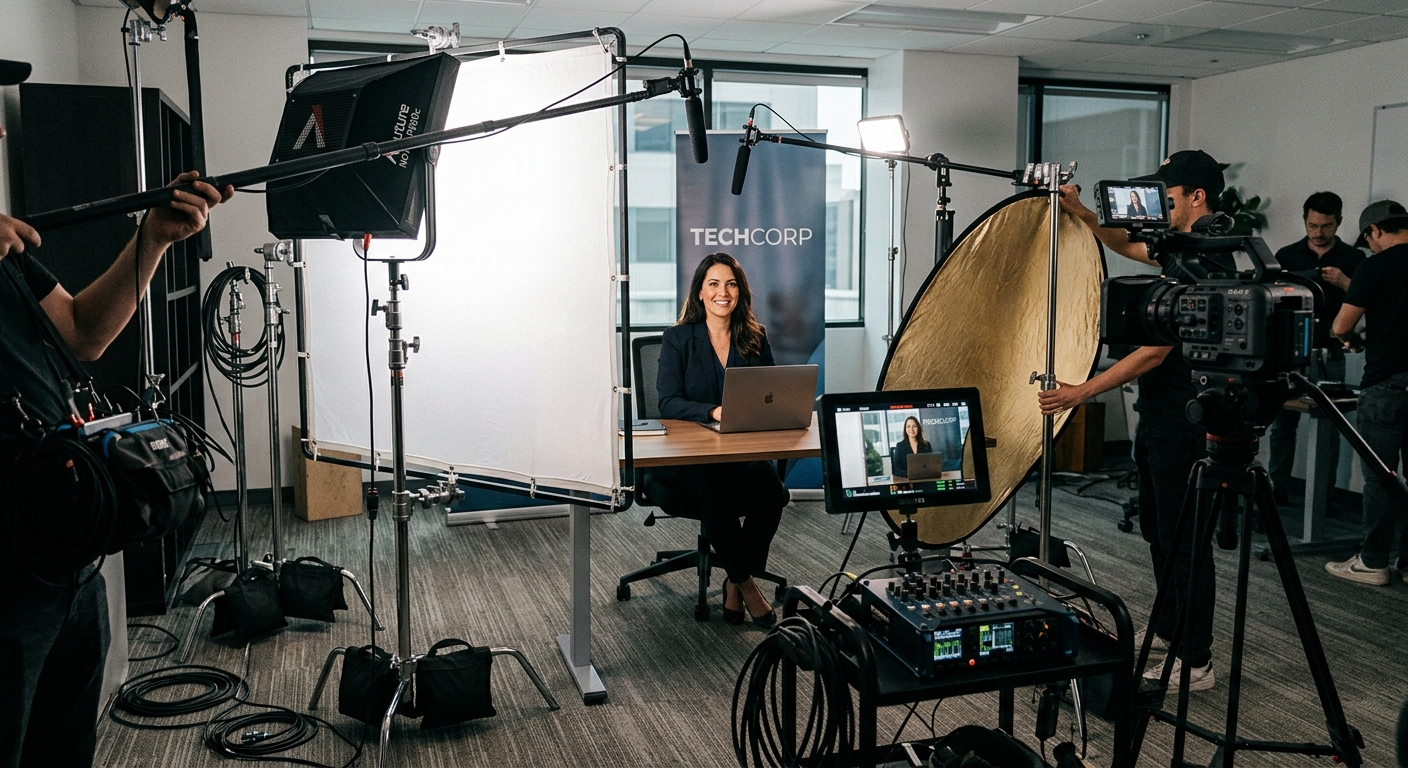
Cameras capture light — they don’t create it. The lighting setup defines mood, perceived production value, and how much time the colorist spends in post fixing problems that should have been solved on set.
A practical commercial lighting kit includes:
Key lights: The primary light source on your subject. LED panel lights — ARRI Skypanel, Aputure 600d, Litepanels Gemini — have replaced HMI units for most location work because of lower power draw and daylight-balanced output.
Fill and negative fill: A fill source softens shadows from the key. A black flag or black card increases contrast and separation when the image needs more depth.
Background lights: Lighting the background independently from the subject gives you ratio control and visual depth in the frame. Flat lighting makes everything look like a Zoom call.
Modifiers: Softboxes, octaboxes, and diffusion material control how hard or soft the light falls on your subject. Hard light creates drama and definition. Soft light flatters skin and reads as approachable.
One thing that surprises clients on their first commercial shoot: the lighting package often costs as much as or more than the camera package, and it takes longer to set up. If you want to understand what your crew is building on set, lighting techniques for video production walks through the logic behind each light’s purpose.
Support Equipment: The Infrastructure Nobody Talks About
Camera support is the difference between footage that commands attention and footage that makes viewers seasick.
Tripods and fluid heads: A quality fluid head — Miller, Vinten, O’Connor — on a solid tripod is non-negotiable for interviews, product shots, and anything that needs to hold still convincingly.
Gimbal stabilizers: For moving shots without dolly infrastructure, a 3-axis gimbal (DJI RS3 Pro, Tilta Gravity) delivers smooth motion. They require a skilled operator. A gimbal in the wrong hands is still shaky footage.
Sliders: Subtle horizontal movement adds visual energy to shots that would otherwise feel static.
Jibs and cranes: For overhead reveals and dramatic framing when the budget allows.
Dollies: Traditional dolly and track setups build slower but deliver the smoothest, most controlled motion available.
What Gets Forgotten
Two support items crews consistently underpack: C-stands and sandbags. A set without enough C-stands is a set where people are holding things by hand for an hour. Sandbags keep light stands from tipping in outdoor shoots or high-traffic locations.
Power, Monitoring, and Data Management
Three categories that disappear from budget estimates until something goes wrong on set:
Batteries and power: V-mount or Anton Bauer battery systems for cameras and accessories. Battery-powered lights for location flexibility. Power strips and line conditioners for studio work to avoid voltage issues from overloaded circuits.
On-set monitors: A calibrated monitor lets the director and client see a real image, not the small camera screen with its compressed preview. SmallHD, TVLogic, and Flanders Scientific make the standard options.
Data management: Memory cards fill up faster than most people expect. Budget for enough media to cover your shooting ratio, and designate someone to back up cards to at least two drives on set. Footage loss is not recoverable. It’s not a lesson you learn twice.
Post-Production: Where the Story Gets Finished
The equipment list doesn’t end at wrap. Post-production requires its own infrastructure:
- Editing workstation: A high-spec Mac or PC with RAM and GPU headroom to handle 4K or 6K RAW footage without proxy workflows grinding things down
- Color-calibrated reference monitor: Grading on an uncalibrated screen produces results that look different on every other screen
- Storage and backup: A RAID array plus offsite backup — cloud or physical — at minimum
- Software: DaVinci Resolve or Premiere Pro for editing; DaVinci for color grading; Pro Tools or Audition for audio finishing
Working with a Professional Production Team
For most businesses in the Bay Area, the math is clear: hiring a professional production company is more cost-effective than building and maintaining a full kit. A camera package alone can represent $50,000–$150,000 in gear before you add lighting, audio, and support equipment.
The businesses that benefit most from understanding this equipment list aren’t building their own kits. They’re using it to evaluate proposals, ask sharper questions of vendors, and set realistic expectations for what different budget levels actually produce.
Our team handles San Jose video production for corporate clients, commercial brands, and businesses across the South Bay. We match the kit to what the project needs — not the maximum we can invoice for. If you’re planning a video project and want to understand what goes into a professional production, start with the services page to see the range of formats we work in.
Frequently Asked Questions
What camera should I use for a corporate video shoot?
For most corporate and commercial work, a mirrorless hybrid like the Sony FX3 or FX6 delivers broadcast-quality 4K footage with strong low-light performance. Camera choice matters less than the lenses, lighting, and audio around it — a mediocre camera with great glass and light beats a great camera under bad conditions.
How much does a professional video production equipment package cost?
A full commercial production kit — camera, lenses, lighting, audio, and support — runs $50,000 to $150,000 to own. Most businesses rent through a production company, which folds equipment costs into the project rate and brings a crew that knows how to use it.
Do I need a separate audio recorder for video production?
Yes, for anything beyond casual run-and-gun content. A dedicated field recorder like the Sound Devices MixPre series captures cleaner audio than camera-internal recording and gives the sound mixer independent control of each channel during the shoot.
What lighting equipment is essential for a corporate video shoot?
At minimum: a key light (LED panel with softbox modifier), a fill source, and a background light. Adding a hair or rim light and a flag for negative fill significantly increases the professional look. The light package often costs as much as the camera package on a commercial production.
How do I evaluate whether a video production company has the right equipment for my project?
Ask for a specific equipment list in their proposal. A professional crew should tell you what camera, lenses, audio package, and lighting they’re bringing — and why those choices suit your project. Vague answers about ‘professional gear’ are a red flag.
