
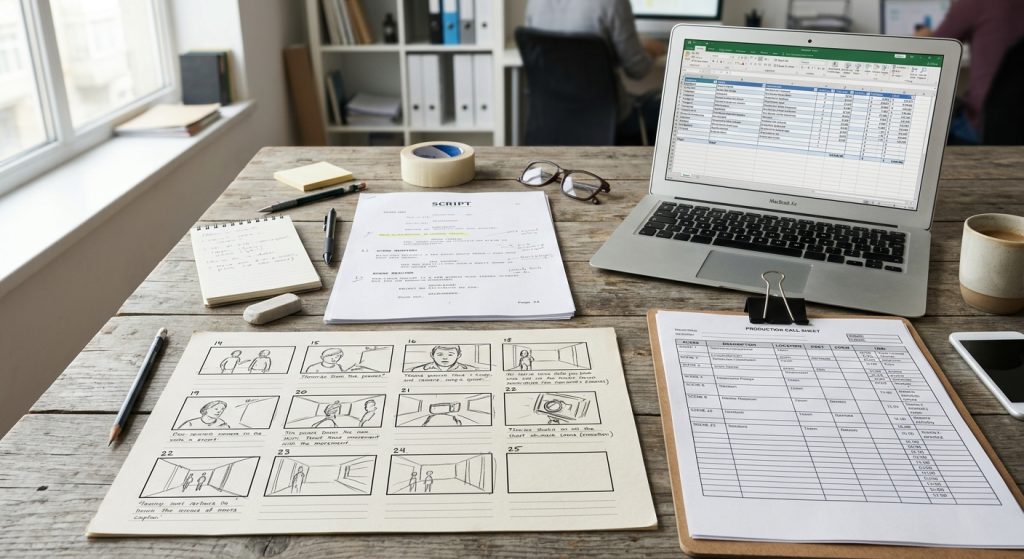
A Fresno restaurant group called us on a Tuesday. Shoot was Friday. They had a rough script, no locked locations, a “maybe” from two actors, and a budget number that existed only in an email subject line. We got them to set on time, but it cost everyone three sleepless nights that never needed to happen.
That’s the thing about the steps in pre production planning: skip or rush any one of them and the shoot day doesn’t get easier, it gets more expensive. Every hour you don’t spend planning in the weeks before a shoot turns into two hours of scrambling on the day itself, paid at crew day rates. We’ve run this process on everything from thirty-second social spots to multi-day commercial shoots for Fresno video production clients, and the order below is the one that actually holds up under a real deadline.
The Steps in Pre Production Planning We Actually Use on Every Job
There’s a reason production companies all land on roughly the same sequence. Concept and budget come first because they constrain everything downstream — you can’t scout locations for a shoot you can’t afford, and you can’t cast actors for a script that doesn’t exist yet. Each step depends on the one before it, which is exactly why skipping ahead causes rework instead of saving time. If you want the fuller walkthrough of this process with more detail on documentation and templates, our pre production guide covers the paperwork side of it. Here’s the sequence, step by step, the way we run it internally.
Step One: Lock the Concept, the Budget, and the Deadline
Before a single call is made to a location owner or an actor, you need three numbers nailed down: what the video is actually for, what it costs, and when it airs or launches. Vague concepts are the single biggest source of wasted pre production hours — “something upbeat about our team culture” is not a concept, it’s a mood. A real concept states the audience, the platform, the length, and the one thing you want a viewer to do after watching.
Budget has to get locked here too, not negotiated during scouting when a location fee suddenly eats a third of your day rate. We walk clients through a full breakdown of crew, gear, locations, talent, and post costs before anything else moves forward — our guide on how to create a production budget shows exactly how those line items break down and where most first-time producers underestimate. Get this number wrong in week one and you’ll be renegotiating it in week three, usually with a location already booked and a crew already holding the date.
Step Two: Turn the Idea Into a Script Crew Can Actually Shoot
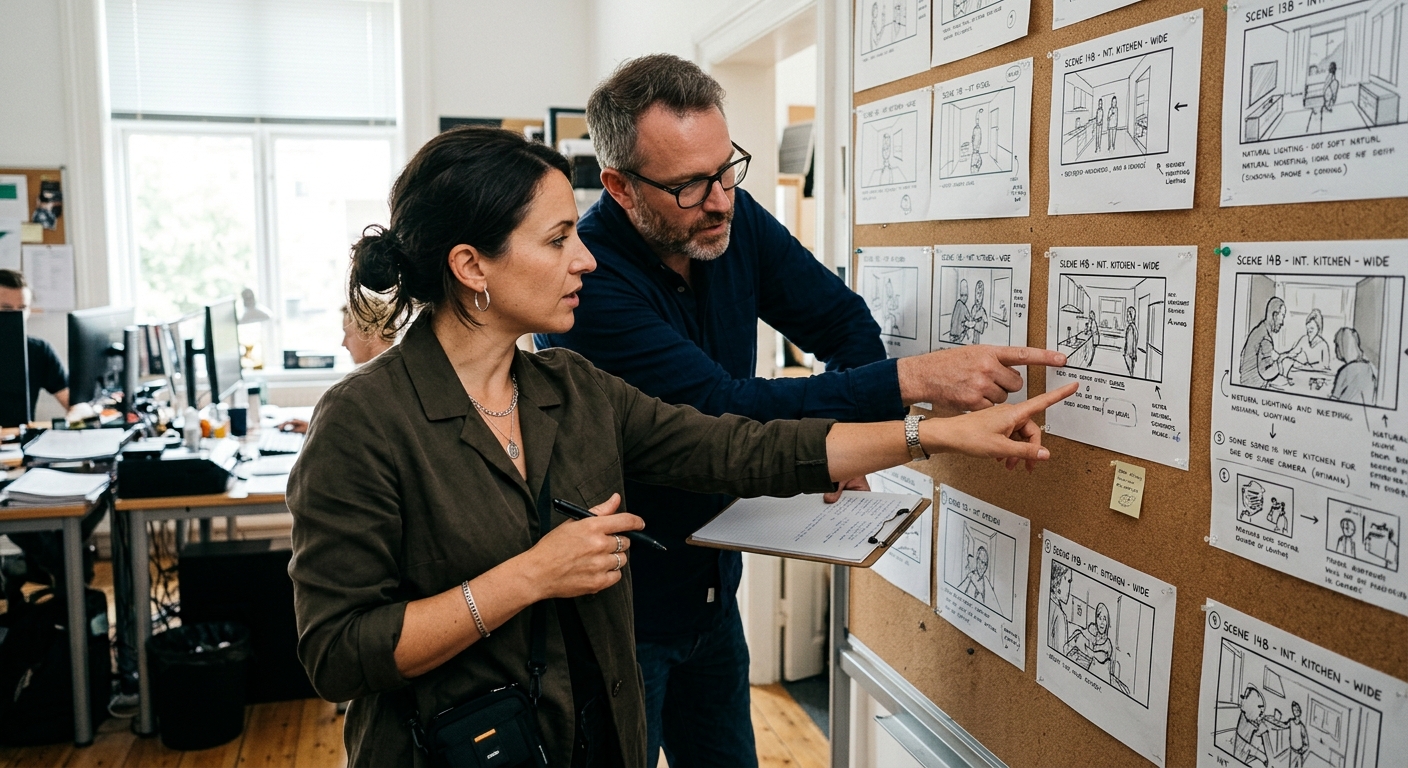
A concept is not a script, and a script is not a shot list. This step is where a lot of small businesses try to shortcut the process by handing a crew a paragraph of bullet points and calling it direction. That works for nobody. A shootable script breaks dialogue and action into scenes, notes location needs scene by scene, and flags anything that requires special equipment, permits, or extra crew — a drone shot, a night exterior, a product macro.
Storyboards matter more here than most clients expect. They’re not decoration; they’re how a director of photography prices out lenses and lighting before the truck ever leaves the shop, and how a client catches a misunderstanding about tone before it’s committed to film. If your project involves any kind of narrative structure or brand story, this is also the stage to think about what your team can and can’t produce in-house — our full production services page lays out where we typically bring more hands and gear than a lean internal team can staff for a single shoot day.
Step Three: Scout Locations and Book Your Cast Early
Locations and casting move in parallel, and both take longer than people budget for. A location that looks perfect in a phone photo often has a parking lot too small for a grip truck, a noise problem from a nearby freeway, or an owner who wants a fee nobody mentioned during the first call. Scout in person, at the actual time of day you plan to shoot, and get permission in writing — a verbal yes from a manager means nothing if the owner shows up during your load-in.
Casting has the same trap: waiting until two weeks out to start auditions means settling for whoever’s available instead of whoever’s right. If your concept calls for a spokesperson, a testimonial subject, or background talent, start that process the same week you lock the script. We’ve written more on the mechanics of building out a full shoot day around locations and cast timing in our piece on how to plan a video shoot, which is worth a read before you send the first scouting text.
Step Four: Build the Shot List, Book Gear, and Assemble Your Crew
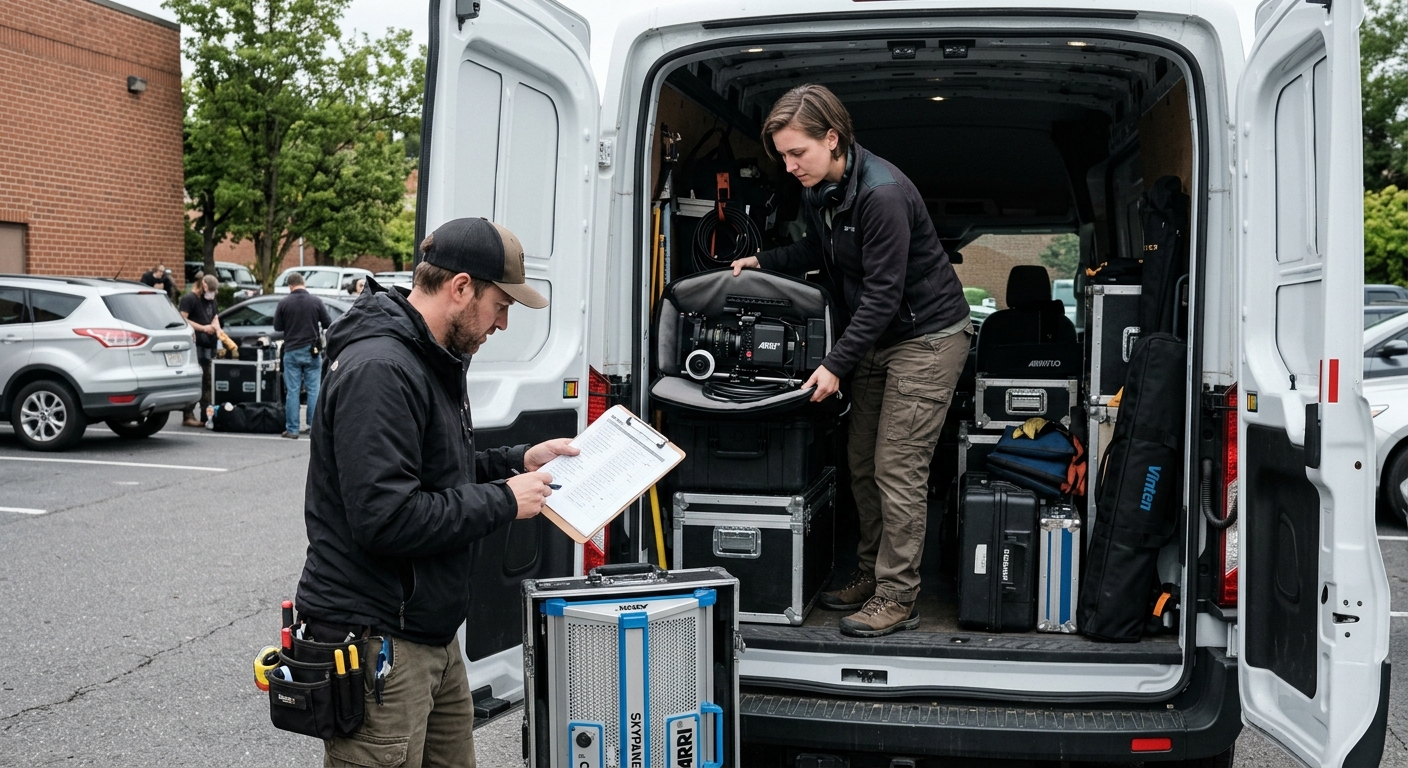
Once locations and cast are locked, the shot list becomes your actual production document — not the script, not the storyboard, the shot list. It tells the DP what glass to bring, tells the gaffer how many lights and what size, and tells the AD how many setups fit into daylight hours. A realistic shot list also protects your budget, because it’s the document that reveals whether you’ve scheduled eight hours of coverage into a six-hour window before it becomes an expensive surprise on set.
Gear and crew get booked off this list, not before it. Booking a full lighting package before you know whether you’re shooting an interior interview or a run-and-gun exterior wastes rental money either way. This is also when you confirm insurance, permits, and any specialty equipment — drones, jibs, underwater housings — need extra lead time and sometimes extra licensing that can’t be sorted out the week of the shoot.
Step Five: The Call Sheet Is Where Planning Becomes Reality
Everything above funnels into one document: the call sheet. It lists call times, addresses, weather, contact numbers, shot priorities, and a backup plan if weather or a location falls through. A good call sheet means a first-time PA and a fifteen-year gaffer both know exactly where to be and what’s happening without asking anyone a single question on arrival.
Do a final walkthrough against the call sheet forty-eight hours out. Confirm every location contact answers their phone, every cast member has directions and a call time, and every crew member has confirmed gear is pulled and loaded. This is the last checkpoint where a gap costs you a phone call instead of a delayed shoot day.
What Skipping a Step Actually Costs You
We’ve seen every version of this go wrong. A client who skipped location scouting discovered on shoot morning that their “quiet office” backed up to a delivery dock. A client who skipped a real budget conversation ran out of money for color correction and delivered a video that looked unfinished. A client who skipped casting prep sat through four hours of auditions the day before the shoot and picked from whoever hadn’t already booked other work.
None of these were gear problems or crew problems. They were planning gaps, and every one of them was fixable with a week of lead time nobody set aside. The steps in pre production planning aren’t bureaucracy — they’re the difference between a shoot day where problems get solved calmly at 9am with a phone call, and one where they get solved in a panic at 2pm with the whole crew standing around on the clock.
Frequently Asked Questions About Pre Production Planning
How long should pre production planning take for a typical commercial video?
For a single-day shoot, plan on two to four weeks of pre production. Multi-day or multi-location projects, or anything involving casting and permits, often need six to eight weeks to do properly.
What’s the most common pre production mistake small businesses make?
Locking a shoot date before locking a budget. Once a date is set, every other decision gets rushed to fit it, and budget conversations happen under pressure instead of with room to compare options.
Do I need a full script, or can we work from an outline?
For interviews and documentary-style content, a detailed outline with key questions is usually enough. For narrative, scripted, or brand story content, a full script is worth the extra time because it’s what a crew actually prices and shoots from.
Who should be involved in the pre production meetings?
At minimum, the director or producer, whoever controls the budget on the client side, and the DP if the shoot has any technical complexity. Bringing in the whole crew too early wastes time; bringing them in too late means gear gets booked based on guesses.
Can a production company handle pre production if we already have a script?
Yes, and it’s a common starting point. Handing over a locked script or concept lets a production team move straight into budgeting, scouting, and scheduling without spending time developing the creative from scratch.
