
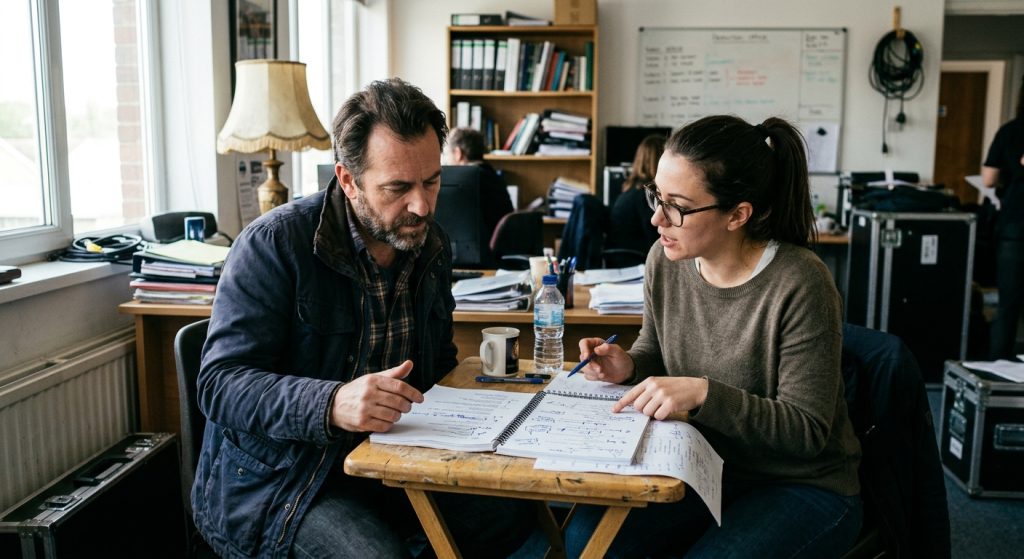
Every business owner who walks into our studio has the same fear, even if they never say it out loud: they’re going to spend real money on a video, and it’s going to come back polished, professional, and completely forgettable. That’s not a lighting problem or a camera problem. It’s a structure problem. Nine times out of ten, when a finished video falls flat, the crew nailed the shots and missed the story. Storytelling frameworks for video exist to fix exactly that, and after two decades of scripting everything from 30-second spots to hour-long documentaries, I can tell you the framework you pick before you ever call a crew matters more than almost any decision you’ll make on set.
I want to walk through the four frameworks we actually reach for, when each one earns its keep, and why “just tell our story” is the phrase that kills more corporate videos than bad audio ever has.
Why Storytelling Frameworks for Video Matter More Than Your Budget
Clients come to us assuming better cameras and bigger crews fix weak videos. They don’t. We’ve shot gorgeous 4K footage of a founder explaining their software platform, dropped it in the edit bay, and watched it die in the first fifteen seconds because there was no reason for anyone to keep watching. Meanwhile, some of the highest-converting videos we’ve produced were shot on a single camera in an afternoon, because the script had a spine.
A framework isn’t a formula that flattens your creativity. It’s scaffolding. It tells your editor where the tension goes, tells your voiceover talent where to slow down, and tells your viewer, in the first five seconds, why this is worth ninety more. If you skip that step and jump straight to a shot list, you’re building a house by picking paint colors before you’ve poured a foundation. This is also where we start the conversation with every client who reaches out through our services page — not “what do you want to show,” but “what does the viewer need to feel by the end.”
The Three-Act Structure Still Works, Here’s Why
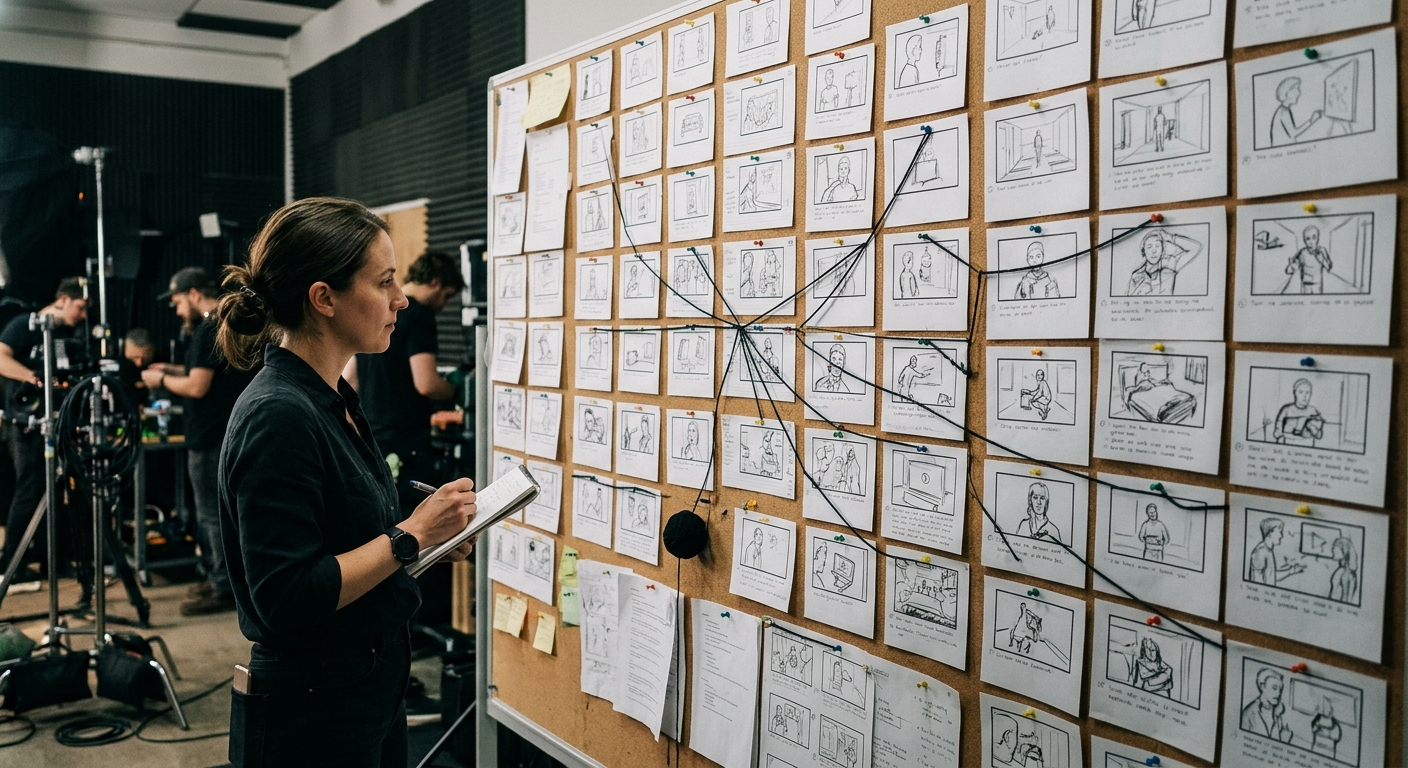
Setup, confrontation, resolution. It’s the oldest trick in the book because it maps onto how people actually process information. In a corporate or brand video, the setup is the world before your product existed — the friction, the workaround, the thing people just lived with. The confrontation is the moment that friction becomes unbearable or a decision has to get made. The resolution is your product or service, but framed as a consequence of the story, not a tacked-on pitch.
Where people mess this up is pacing. They spend eighty percent of their runtime on the setup because it feels safe and informative, then rush the resolution in the last ten seconds. Flip that ratio. Get to the confrontation fast — inside the first twenty seconds of a two-minute video — and let the resolution breathe. That’s also where storyboarding earns its cost; if you want a deeper look at why we storyboard even simple projects, we’ve written about how storyboards improve video outcomes before a single frame gets shot.
StoryBrand and the Problem With Making Your Company the Hero
Donald Miller’s StoryBrand framework flipped a switch for a lot of marketing teams, and for good reason: it forces you to cast your customer as the hero and your company as the guide. Not the star. The mentor character. Think Yoda, not Luke.
Businesses resist this instinctively because they’re paying for the video and they want to see themselves front and center. But viewers don’t root for companies. They root for people solving problems, and they trust guides who’ve clearly helped someone through the exact problem they’re facing. In practice, this means your CEO doesn’t open the video talking about the company’s twenty-year history. A customer, or a customer stand-in, opens it talking about the mess they were in. Your brand shows up as the answer, not the headline act.
This is one of the frameworks we lean on hardest for service-based businesses in the valley, and it’s a big part of why local shoots for our Fresno video production clients start with a half-hour conversation about the client’s actual customers before we talk about locations or gear.
The Hero’s Journey, Scaled Down for a 90-Second Spot
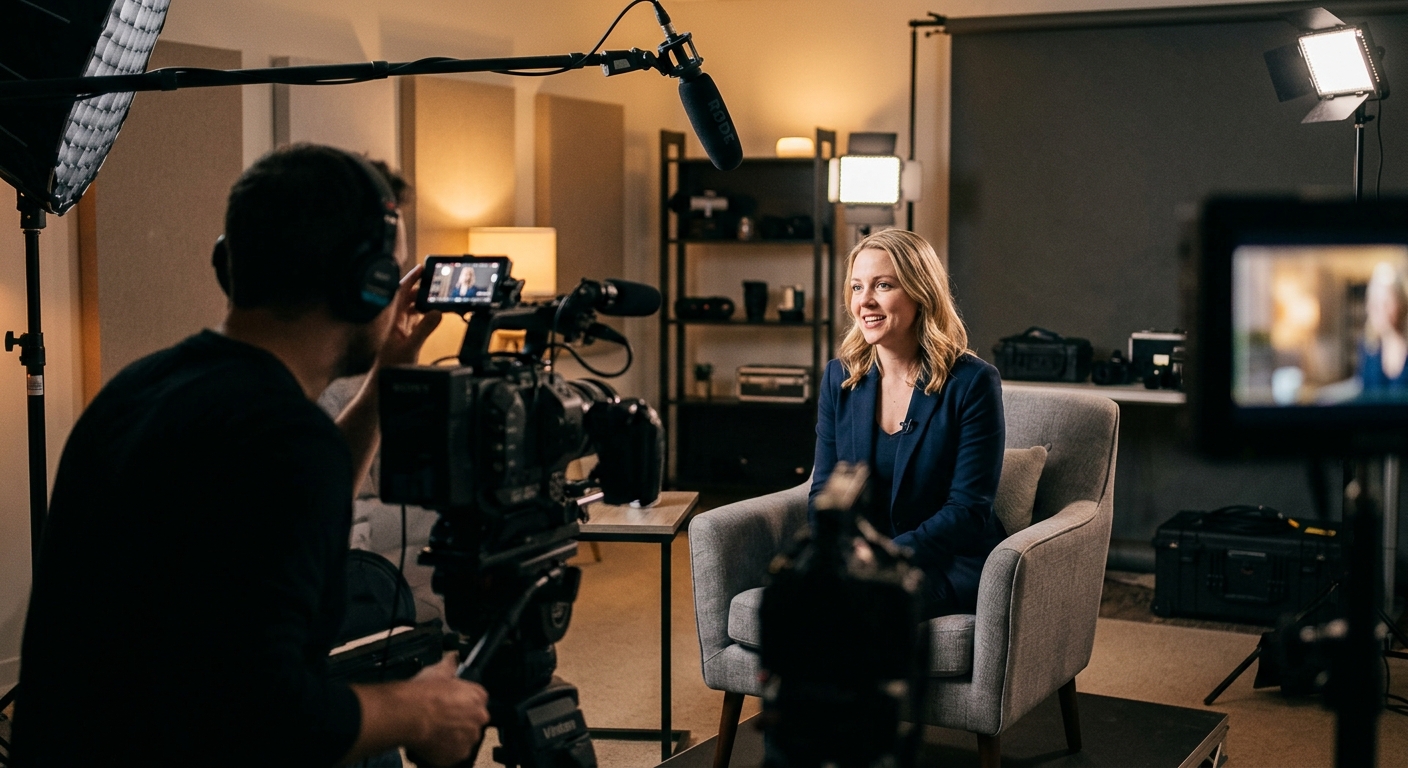
You don’t need Joseph Campbell’s full seventeen-stage monomyth to make a testimonial video sing. But the compressed version — ordinary world, call to adventure, trial, transformation, return — maps beautifully onto customer testimonials and case study videos, which is where we use it most.
A manufacturing client of ours had a testimonial subject who kept giving flat, generic answers on camera: “they were great to work with, very professional.” Useless footage. So we stopped asking about the company and started asking about her ordinary world before the partnership — the missed deadlines, the vendor who ghosted her twice. Then the call to adventure: the referral that got her to pick up the phone. Then the trial: the skepticism, the first project that could have gone wrong. The transformation came out of her own mouth, unscripted, because we’d built the interview around a structure instead of a list of talking points. That’s the difference between a testimonial that sounds like a Yelp review and one that actually changes a buyer’s mind.
Before/After/Bridge for Fast, Punchy Sales Content
Not every video has room for a three-act arc. Social ads, pre-roll, anything under thirty seconds needs something blunter, and Before/After/Bridge is the workhorse for that. Show the painful before. Show the appealing after. Spend one line on the bridge — your product or service — that gets the viewer from one to the other.
It’s not subtle, and it’s not meant to be. This framework is built for attention spans measured in single-digit seconds, where a viewer is deciding whether to keep scrolling before your logo even shows up. We reach for it constantly on paid social work, and it pairs well with understanding where the viewer actually is when they hit play — which is really a question about how customer journey influences video content and what job the video needs to do at that specific touchpoint, awareness versus consideration versus a final push to convert.
Picking the Right Framework for Your Business
Here’s the honest answer nobody wants: it depends on the ask, not on personal preference. A recruiting video for a healthcare system needs the emotional runway of a hero’s journey, because you’re asking someone to picture their career changing. A software demo for a niche B2B tool needs StoryBrand’s clarity, because the buyer is scanning for “will this guy understand my specific headache.” A retail promo running as a fifteen-second Instagram story needs Before/After/Bridge because nobody is going to sit through act two.
The mistake we see most often is businesses picking a framework based on what their competitor did, or what won an award somewhere, rather than what matches their sales cycle and their audience’s attention span. A framework is a tool matched to a job, not a brand identity. Once you’ve picked one, the actual writing gets a lot more mechanical than people expect, and we’ve broken down that process in how to write a compelling video script if you want to see how a framework turns into an actual page of dialogue.
How We Build the Script Before We Ever Book a Crew
Every project starts with the same question in the room, before locations, before casting, before gear lists: who is the hero, what do they want, and what’s stopping them. Once that’s nailed down on paper, the framework almost picks itself, and everything downstream gets easier — the shot list writes itself around the structure, the director knows where to hold on a reaction shot, and the editor knows exactly where the story needs room to breathe versus where it needs to move.
If you’ve got a project in mind and you’re not sure which structure fits, that’s a conversation worth having before you write a single line of script. We’d rather spend forty-five minutes talking through your actual customer’s problem than hand you a template that looks good on paper and falls apart in the edit bay.
Frequently Asked Questions
What’s the difference between a storytelling framework and just writing a script?
A framework is the underlying structure — where tension builds, where the resolution lands — while a script is the actual dialogue and shot-level detail. You can write a technically good script that still fails because it has no framework underneath it, which is why we build the structure first.
Which storytelling framework works best for a company’s first-ever brand video?
StoryBrand tends to work well for a first video because it forces clarity about who the customer is and what problem you solve, which most companies haven’t articulated cleanly yet. It also translates easily into later videos once you have the core positioning locked in.
Do short social media videos need a storytelling framework too?
Yes, just a leaner one. Before/After/Bridge is built for videos under 30 seconds because it gets to the payoff fast without the setup a longer format allows for.
How long does it take to develop a script using one of these frameworks?
For a typical 60- to 90-second brand or testimonial video, scripting usually takes one to two weeks, including a discovery call, a draft, and one round of revisions. Complex projects with multiple stakeholders can take longer.
Can a framework be applied to documentary-style or long-form video?
Absolutely, and it matters even more there. Long-form content without a clear structural spine tends to wander, which is why documentary-style pieces often lean on a scaled-up three-act structure or a hero’s journey to keep an hour of footage feeling purposeful.
