
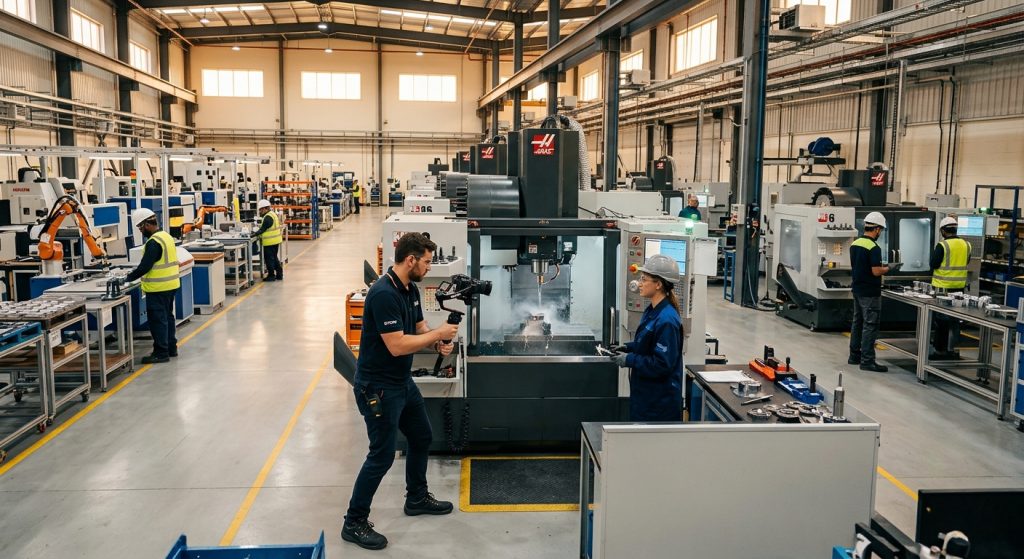
A buyer’s procurement team will not drive to your plant before they shortlist you. They will watch a video of it, usually muted, usually in under two minutes, and decide whether your operation looks like one that ships on time. That is the real job of factory tour video production: letting a stranger walk your floor from a conference room three states away.
Done badly, it is a shaky walk past machines with a voiceover reading the brochure. Done well, it is the strongest trust asset a manufacturer owns. Here is how we plan and shoot these, and what they cost.
What Does Factory Tour Video Production Actually Involve?
Factory tour video production is the planning, filming and editing of a guided visual walkthrough of a manufacturing facility, built to show capability, cleanliness, scale and people. A good tour follows the real flow of product: receiving, fabrication or assembly, quality control, packing, shipping.
Most tours end up as one hero cut of 90 seconds to 3 minutes, plus a stack of shorter pieces pulled from the same footage. A trade-publication guide to plant tour videos from PMMI Media Group recommends keeping the main video to roughly 1 to 3 minutes and limiting it to three to five chunks of information. We agree. Anything longer belongs in a separate technical or training piece.
If you want the broader picture of how tours fit alongside capability reels, safety and recruiting films, our guide to industrial video production covers the whole category. Our manufacturing video production services page shows how we package it.
Why Do Manufacturers Need a Factory Tour Video?
A factory tour video shortens the sales cycle by answering the question every B2B buyer has: can this shop actually do what it says? It replaces a site visit for early-stage prospects and prepares serious ones for the real visit.
The wider data backs video as a channel. In Wyzowl’s 2026 State of Video Marketing survey, 82% of marketers said video delivers good ROI, and about 91% of businesses now use video as a marketing tool. Those are general marketing numbers, not factory-specific, but they explain why procurement teams expect to see you on screen.
Tours also do quiet work beyond sales:
- Recruiting. Skilled-trade candidates want to see the floor, the equipment age and the people before applying.
- Investor and distributor confidence. A clean, organized line signals discipline faster than a slide deck.
- Audit and customer visits. Out-of-town customers can pre-screen your process before a quality auditor travels.
How Much Does a Factory Tour Video Cost?
A single-day factory tour video with a small crew typically runs $4,000 to $12,000 in the US, depending on plant size, number of deliverables, and whether you add drone or interview coverage. Premium multi-day productions with animation and multiple interviews can reach $20,000 or more.
Cost drivers are mostly predictable. Crew and equipment are priced by the day, so the cheapest approach is filming everything in one session. A UK production company’s breakdown of a Glasgow facility tour for SPIRE Global estimated about £3.5-4.5k for a one-day shoot with two cameras and three days of post, with no voiceover and only simple graphics. Voiceover, original animation, a slider or crane, and extra cutdowns for social all add line items.
Post-production time scales with footage volume, the number of deliverable versions, and revision rounds. If you are building a budget from scratch, our walkthrough on how to create a production budget shows where the money usually goes.
How Do You Plan a Factory Tour Shoot?
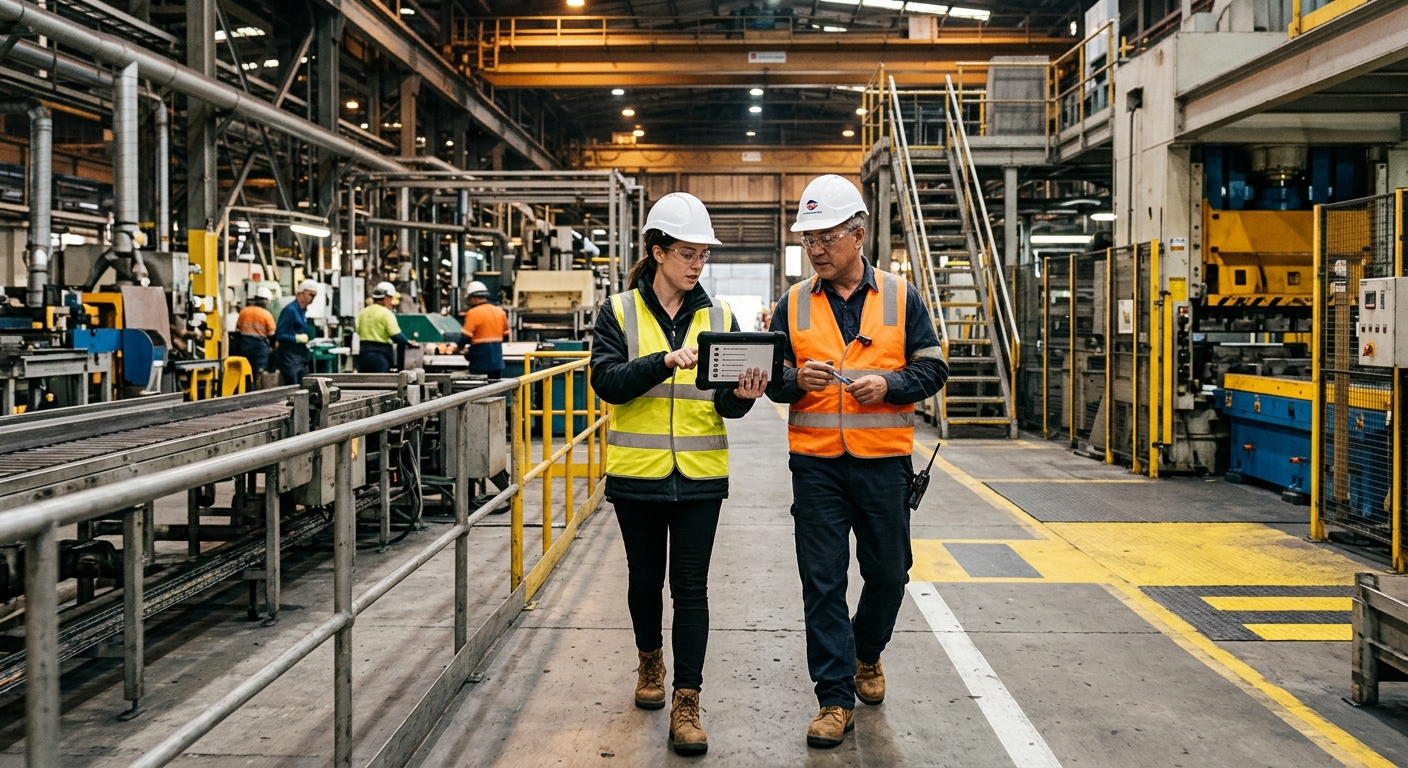
Plan a factory tour shoot around one site walk-through, a written shot list, and a schedule that follows your real production shifts. The scout visit matters most, because that is when we find the hazards, the dead zones, the loud machines and the areas you would rather not show.
Our checklist before any plant day:
1. Scout the floor. Note PPE rules, restricted zones, evacuation routes, and where forklifts and overhead cranes travel.
2. Decide the route. Follow the product, not the org chart.
3. Build a shot list. Close-ups of hands and tooling, wide establishing shots, exterior and entrance, and people at work. Our guide to writing a shot list and planning a video shoot go deeper.
4. Flag the sensitive items. Proprietary processes, customer-named parts, whiteboards and screens need a sign-off or a blur. Some plants bar shots of specific equipment entirely, as in Li-Cycle’s published filming guidelines.
5. Schedule during normal shifts. Empty machines look dead on camera. Confirm which lines will be running and who is presenting each area.
A plant of about 120,000 square feet usually fits in one full day, with an extra half day if you want drone or second-unit interior coverage, according to vendor guidance we have seen and our own experience. Smaller job shops can often be done in half a day.
What Safety and Access Rules Apply on the Floor?
Every person in the crew follows the plant’s own safety rules, which usually means full PPE, a site induction before arrival, and staying inside marked walkways. Typical minimums are safety glasses, hard hat or bump cap, hi-vis vest, closed-toe boots and hearing protection.
Anyone who appears on camera should wear the same PPE as everyone else on the line. Nothing sinks credibility with a safety-minded buyer faster than an operator without glasses next to a grinder. We also keep cables, light stands and tripod legs out of walkways, and we ask the plant to assign a safety escort for the day.
In Phoenix and the Valley, add heat to the list. Many plants are partly open-bay, and summer afternoons in a metal building are punishing for people and gear. Our Phoenix video production team schedules heavy exterior and loading-dock coverage for early morning and keeps batteries and cameras shaded between setups.
What Shots and Gear Make a Factory Tour Look Professional?
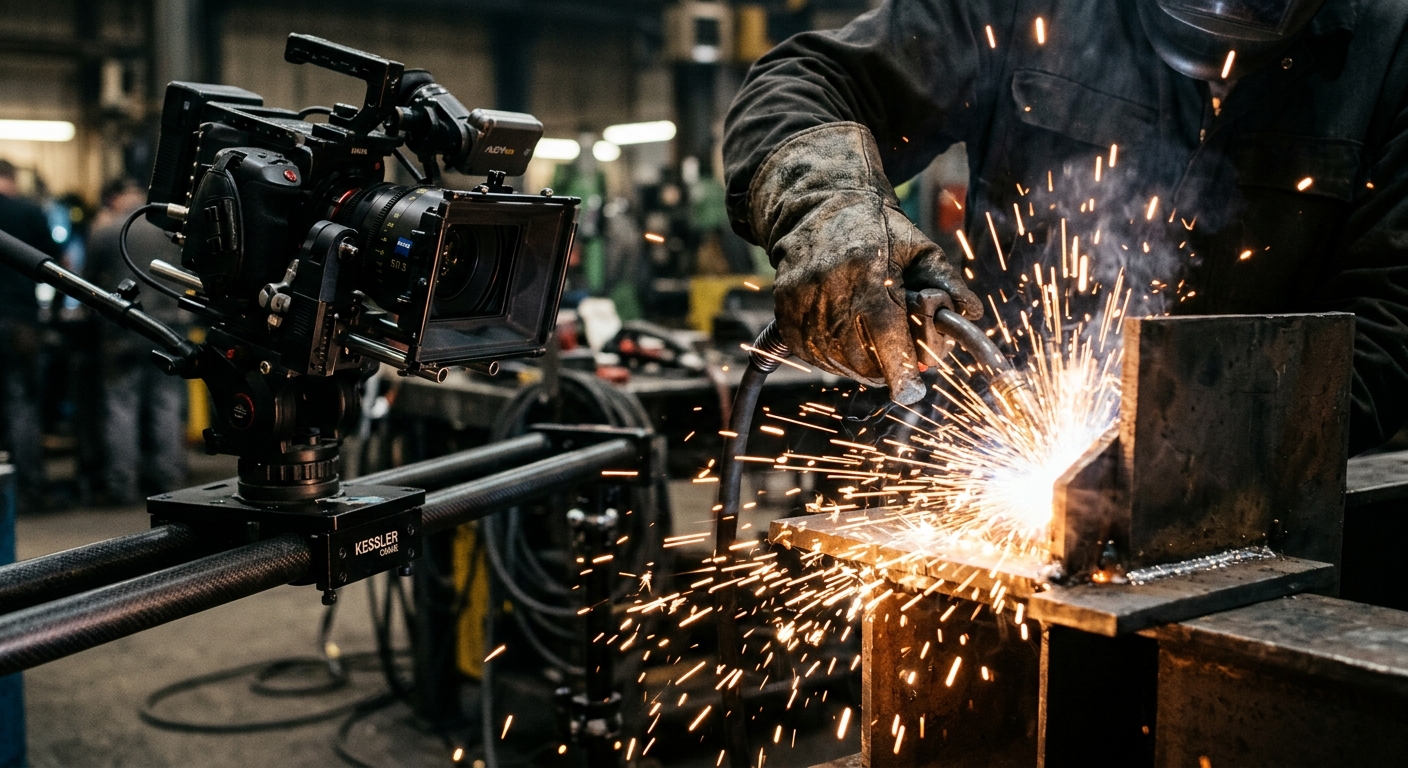
A professional factory tour mixes smooth movement, tight detail shots and real people, shot at 4K with stabilized or gimbal-mounted cameras and clean on-site audio. The details sell the story: sparks, molten metal, laser etch, a gauge reading, a technician’s focused face.
What we bring and why:
- Gimbal or stabilizer for walking shots that follow the product path.
- Slider or short jib for slow reveals of machinery.
- Wireless lav mics for interviews. Plant floors are loud, so we record in the quietest corner available and add room tone.
- Portable LED lighting to lift dark corners without disturbing work. Light faces from the front, never with a bright bay door behind them.
- Drone for large campuses and exteriors, where airspace and plant policy allow. See our notes on using drones in video production.
- Macro and slow-motion (60 to 120 fps) for the visual payoff moments.
Coverage of the actual work is what carries the film, which is why B-roll gets more of our time than the talking heads.
How Long Should a Factory Tour Video Be, and Where Should It Live?
Your main factory tour video should run 90 seconds to 3 minutes, with 15 to 30 second cutdowns for social and email. Put the long version on your homepage or capability page, and the short versions on LinkedIn and YouTube.
Shoot once, deliver many. One plant day can produce a hero tour, a recruiting cut shot vertically, a quality-control spotlight and a handful of equipment clips. Captions matter because many viewers watch muted, though heavy on-screen text fights the visuals. Add a clear call to action to the end: request a quote, book a real visit, download the capabilities sheet.
What Mistakes Ruin a Factory Tour Video?
The most common mistakes are filming a quiet line, over-scripting the plant manager, showing proprietary details, and running too long. Each one is avoidable with planning.
- Dead floors. If the shift is down, reschedule.
- Scripted employees. Give talking points, not memorized lines. People sound sincere when they are explaining their own machine.
- Cluttered backgrounds. A messy workstation behind an interview undermines the message. Tidy the frame, but do not fake it.
- Skipping legal review. Get sign-offs on customer-owned parts and any export-controlled equipment before the edit locks.
Frequently Asked Questions
How much does a factory tour video cost?
A one-day factory tour video with a small crew typically costs $4,000 to $12,000 in the US. Plant size, drone coverage, interviews, voiceover and the number of cutdowns move the price. Multi-day productions with original animation can exceed $20,000.
How long should a factory tour video be?
A factory tour video should run about 90 seconds to 3 minutes for the main version. Add 15 to 30 second cutdowns for social media and email. Longer technical or training walkthroughs work better as separate videos for audiences who already want detail.
How long does it take to film a factory tour?
Most factory tours take one shoot day. A plant of roughly 120,000 square feet usually fits in one full day, and drone or second-unit coverage may add half a day. Small job shops can often be finished in half a day.
Will filming disrupt production on our floor?
A small crew can film during normal shifts with little disruption. We scout first, follow your PPE and safety rules, stay in marked walkways, and plan shots around running lines. Filming live production also gives the footage real activity instead of idle machines.
How do you protect proprietary processes in a factory tour video?
Proprietary details are handled before the shoot and again before the edit locks. We agree on restricted areas during the scout, avoid shooting sensitive equipment and screens, blur or crop anything that slips in, and get written sign-off on the final cut.
