

Most business owners assume that when they pay for a video, they own it. Then a year later they ask the production company for the raw files to make a cutdown, and hear “that’ll be a new quote.” Who owns video footage is one of the most common sources of friction I see between clients and producers, and it is almost always avoidable with two paragraphs in a contract.
Here is the short version. Under U.S. law, the person who creates a video owns the copyright to it by default, and that is usually the production company or the freelancer, not the client who paid. Ownership only moves to you if a signed written agreement says so.
Who owns video footage by default?
By default, the creator owns it. Under U.S. copyright law, copyright belongs to whoever actually makes the work, so a videographer who shoots your project keeps ownership of the footage unless a written agreement transfers it, and paying the invoice does not transfer anything on its own.
The exceptions are narrow. If the person shooting is a true employee acting within their job, the employer owns the footage. That is why a video your in-house marketing coordinator shoots belongs to your company, while the same video shot by an outside freelancer may not.
Most clients never see this default because most production companies write their agreements to hand over the finished video. The trouble starts with everything other than the finished video: raw clips, unused takes, project files, graphics, and the music licenses. A contract that is silent on those leaves you holding one exported file and not much else. A 2026 Web Tonic review of Virginia Beach agencies found that none of the eleven firms it examined published a standard ownership clause at all, which tells you how often this gets settled informally, or not at all.
What does “work made for hire” actually mean?
“Work made for hire” is a legal category where the hiring party, not the creator, is treated as the author from day one. For a freelancer or outside production company to qualify, the video must be specially commissioned, fall into one of nine statutory categories (a part of a motion picture or other audiovisual work is one of them), and both sides must sign a written agreement that says so.
Plenty of contracts skip a step. Stamping “work for hire” on an invoice does nothing. And a corporate video can land awkwardly against those nine categories depending on how it is used, which is why careful producers and lawyers pair the work-for-hire language with a backup: a clause assigning copyright to the client if the work somehow doesn’t qualify. As creator-rights guides point out, labeling something “made for hire” isn’t enough on its own for an independent contractor.
One number shows why the distinction matters. Since the 1998 amendments, a work made for hire is protected for 95 years from first publication or 120 years from creation, whichever ends first, while a work with an individual author lasts for the author’s life plus 70 years, according to 17 U.S.C. § 302. Either way, the footage you commission will outlive your current campaign by decades. Whoever holds the rights will hold them for a long time.
Does paying for the video mean I own it?
No. Paying for a video buys you a license or a deliverable, and copyright transfers only through a signed written assignment or work-for-hire agreement. This is the single most misunderstood point, and it applies in the UK and elsewhere too: one UK legal explainer puts it plainly, saying ownership depends on contract wording, not commercial expectations.
In practice you will see three structures:
- Full assignment. Copyright transfers to you, usually once the final invoice is paid. Cleanest for the client, and it typically costs more.
- Exclusive license. You get the right to use the video, with limits on media, territory or time, and the producer agrees not to hand the same footage to anyone else.
- Non-exclusive license. You can use the finished video as agreed, but the producer keeps ownership and may reuse the footage in a demo reel or even for other clients.
None of these is wrong. A local restaurant that wants one 30-second spot on social media rarely needs a full assignment. A company planning to run the same footage across a website, trade shows and paid ads for five years probably does. Match the structure to the plan, and say it in the contract before the shoot.
Who owns raw footage and project files?
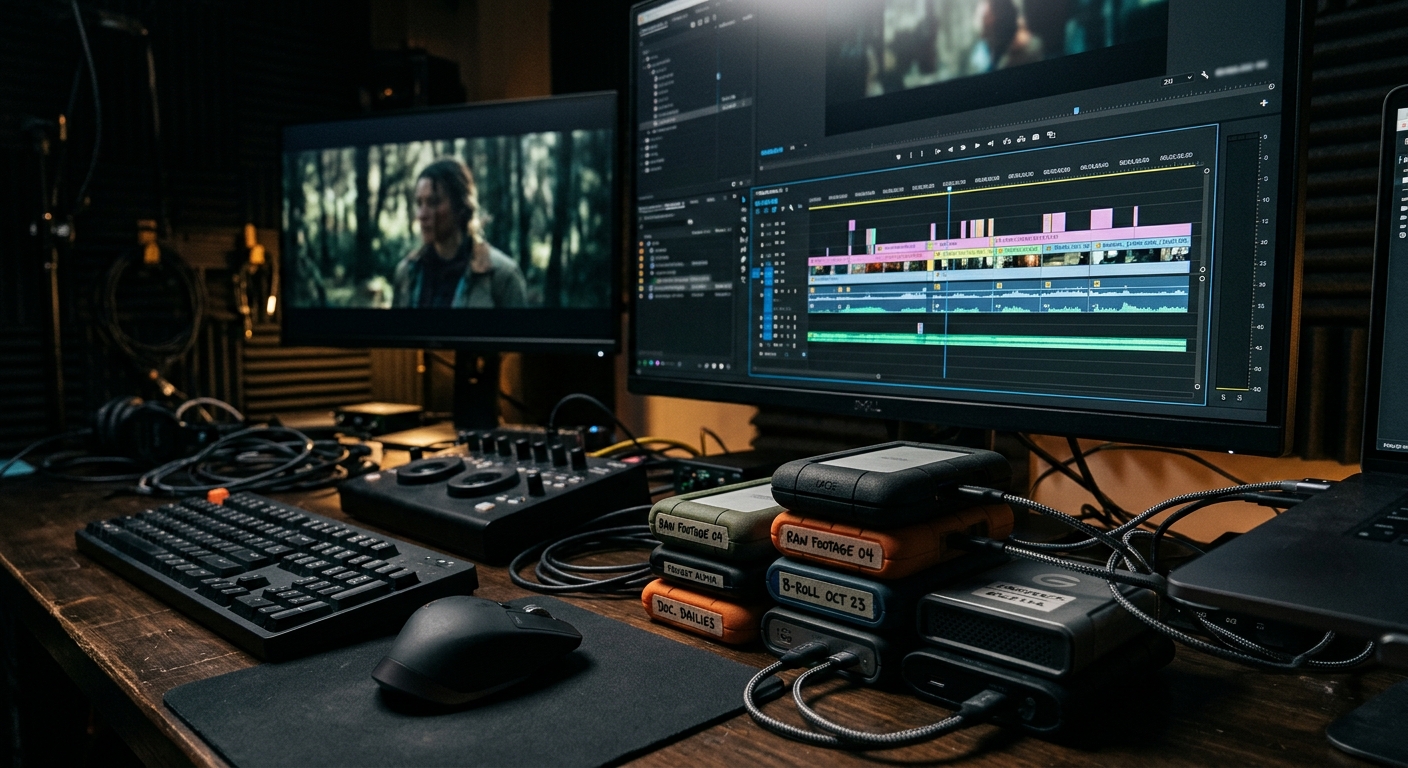
The production company owns raw footage and project files unless the contract says otherwise, and most companies keep them. Raw footage means every clip off the camera cards, including the 90 percent that never made the cut. Project files are the editing timelines, graphics layers and color settings that let someone rebuild or revise the video.
This matters more than it sounds. If you ever want a 15-second cutdown for Instagram, a new tagline, or a different editor, you need either the raw clips or the project files. If the producer keeps them, every future edit becomes a new job at a new price. For a deeper look at how footage becomes a finished piece, see our breakdown of the video post-production process, and note how much of that work lives in files you may never receive.
Your options are to buy the raw footage up front (often priced as a separate line item, commonly a few hundred to a few thousand dollars depending on shoot size and storage), to negotiate an archive period (say, 12 months of storage with access on request), or to accept that you own the final cut only. Any of the three is fine. Not choosing is the expensive one. Footage like B-roll is especially worth asking about, because it is cheap to hand over and valuable for later edits.
What can limit my rights even if I own the footage?
Owning the footage does not guarantee you can use it however you like. Four things routinely cap your rights.
First, music and stock. A production company cannot transfer rights it doesn’t hold. Library music, stock clips and fonts usually carry their own license terms, and a license written for one campaign can expire while your video is still running. Ask for license documents, not just a promise.
Second, people. Footage of employees, customers or talent needs signed releases. Owning the file does not replace a performer’s consent. Location agreements matter too, especially for shoots in private venues, and drones add their own rules; our aerial footage guide covers what changes when the camera leaves the ground.
Third, freelancers. If your production company subcontracted a shooter, editor or colorist, the chain of title only holds if each of them signed over their rights. A good company has this paperwork. Ask to see that it exists.
Fourth, moral rights. In some countries individual creators keep rights such as credit and the right to object to distortion, unless waived in writing. Less of an issue in the U.S. for ordinary commercial video, but relevant if your footage crosses borders.
What should a video production contract say about ownership?
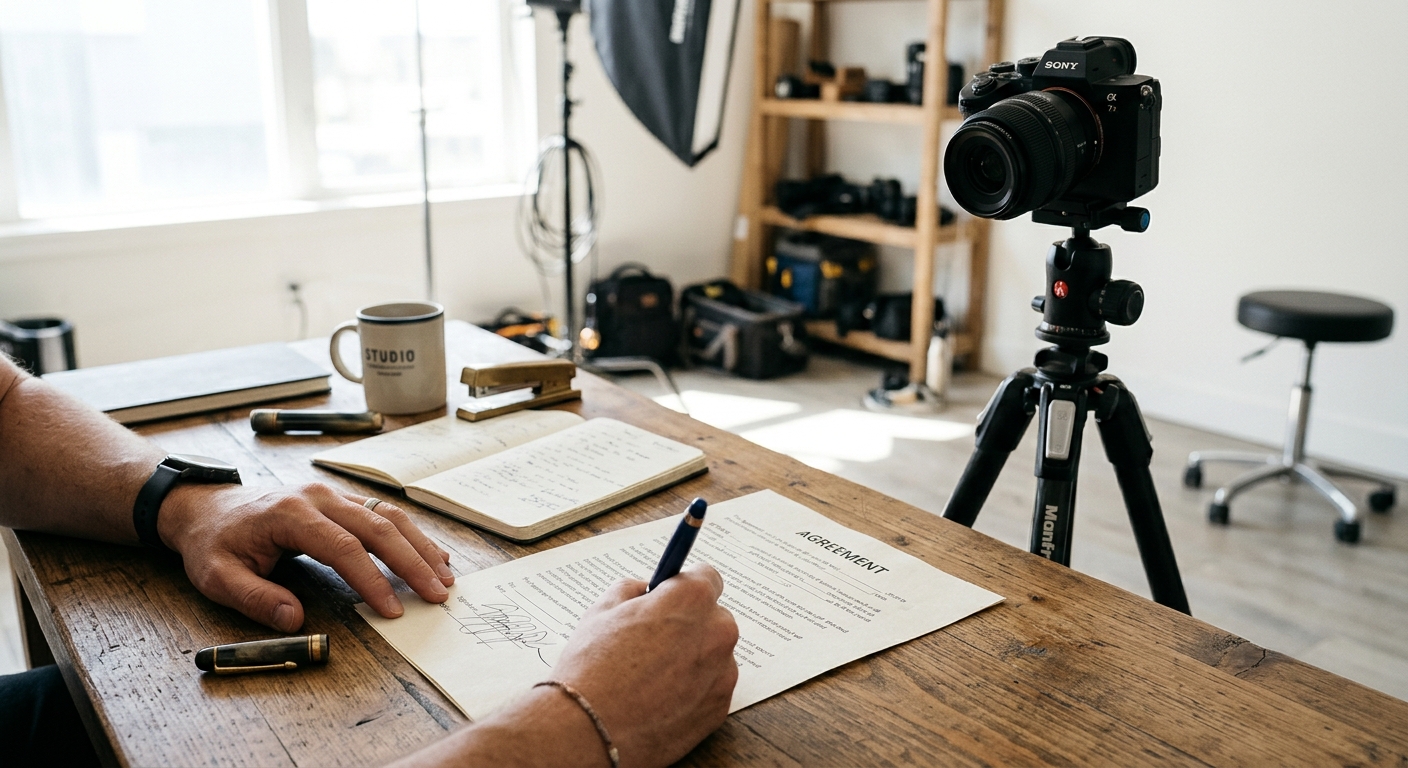
A solid video contract states, in plain language, who owns the final video, who owns the raw footage and project files, what happens to music and stock licenses, and when ownership transfers. Ownership should transfer on full payment, not on signing, so the producer is protected too.
Here is the checklist I give clients before we start:
1. Final video: assignment or license? If a license, what media, territory and duration?
2. Raw footage and project files: delivered, archived, or retained? In what format and on what drive or cloud link?
3. Derivatives: can you edit, recut, translate and resize the video yourself or through another vendor?
4. Third-party assets: which music, stock and font licenses are included, and how long do they last?
5. Releases: who collects talent and location releases, and who stores them?
6. Portfolio use: can the producer show the work publicly, and are there confidentiality limits?
7. Transfer timing: does ownership pass on final payment?
Settle these during scoping, alongside the creative brief and the budget. Our guides to writing an effective video brief and building a production budget are good places to fold these questions in. This article is general information, not legal advice; have an attorney review any contract involving significant rights or money.
How we handle footage ownership at Blare Media
On our own projects, we put the ownership terms in the proposal, not buried in a back page. Clients get the final video in every master format they need, and the license terms for music are listed by name. Raw footage and project files are available as an add-on or, on larger campaigns, part of the package. If you’re a business hiring a crew for the first time, our post on what a video production company does explains where footage fits into the full process, and our services page shows how we scope different project types.
If you’re local, our Fresno video production team is happy to walk through a draft contract with you, including ones from other companies. Send it over before you sign and we will tell you what’s missing. It takes a few minutes, and it can save you from paying twice for footage you thought you already owned.
Frequently Asked Questions
Who owns video footage when you hire a videographer?
The videographer owns the footage by default under U.S. copyright law, even when the client pays for it. Ownership transfers to the client only through a signed written assignment or work-for-hire agreement. If the contract is silent, the client typically has just an implied right to use the finished video.
Do I own the raw footage if I paid for the video?
Not automatically. Paying for a finished video does not include the raw clips, unused takes or project files unless the contract lists them. Many production companies keep raw footage and sell it separately, so ask for it in writing before the shoot, not after delivery.
What is a work-made-for-hire agreement in video production?
A work-made-for-hire agreement is a signed contract stating that a commissioned video belongs to the hiring party from creation. For independent contractors, the video must also fit one of nine statutory categories, such as a part of a motion picture or audiovisual work. Good contracts add a backup copyright assignment.
How long does copyright on a commissioned video last?
For a work made for hire, copyright lasts 95 years from first publication or 120 years from creation, whichever ends first. For a work with an individual author, it lasts the author’s life plus 70 years. Both terms come from 17 U.S.C. § 302 as amended in 1998.
Can a production company reuse my footage for other clients?
Yes, if they own the copyright and your contract grants only a license. They could use it in a demo reel or sell parts of it. To prevent this, request an exclusive license or a full copyright assignment, and add confidentiality terms for anything sensitive.
