
A candidate decides whether they’d want to work for you in about the time it takes to scroll past your job post. Most posts are a wall of bullet points and a stock photo of people laughing at a salad. A good recruitment video swaps that for the one thing text can’t fake: what it feels like to walk in on a Tuesday morning and work next to these people.
The numbers back the effort. CareerBuilder data cited in a 2024 SearchWorks analysis found that job postings with video pulled a 34% higher application rate than postings without it. We shoot these for companies across the Bay Area out of our San Jose video production work, and the same three mistakes show up every time: too long, too polished, and too much CEO. Here’s how we build a recruitment video that brings in people who’ll actually stay.
What is a recruitment video supposed to do?
A recruitment video helps the right candidates say yes and the wrong ones say no before anyone books a screening call. It is not a brand commercial with “we’re hiring” stapled to the end.
That distinction matters because it changes every decision downstream. A brand spot tries to impress everyone. A recruitment video tries to be specific enough that a backend engineer, a line technician or a nurse thinks, “that’s my day, and I could do it here.” Specificity loses some viewers on purpose, and that’s the point. A Glassdoor survey cited by PlayPlay found that half of job seekers wouldn’t take a job at a company with a bad reputation, even for more money, so a video that’s honest about the work beats one that oversells it.
Which types of recruitment video work best?

Employee testimonials and day-in-the-life videos convert best for most employers, with culture films, job previews and leadership messages playing supporting roles. Pick the type by the problem you’re solving, not by what looked good on a competitor’s site.
- Employee testimonials (60-90 seconds): one real person, one honest answer to “why did you join and why did you stay?” This is the workhorse.
- Day-in-the-life (90-180 seconds on a career page, about 30 seconds on social): follows one person through a real shift. Best for roles candidates can’t picture, like a controls engineer or an ICU nurse.
- Job previews and skills demos (60-120 seconds): shows the actual work, tools and pace of one role.
- Culture or employer-branding film (60-120 seconds): the “life at the company” piece for your careers homepage.
- Leadership message (30-60 seconds): a hiring manager talking to the camera about who thrives on the team. Short, or it turns into a speech.
- Facility tours and hiring-process explainers: useful for manufacturing, healthcare and anywhere the first-day nerves are about the building or the interview steps.
Our testimonial video guide covers how to get natural answers out of people who hate cameras, and the different styles of corporate videos breakdown shows where each format fits beyond hiring.
How long should a recruitment video be?
Aim for 30-60 seconds on social, 60-90 seconds for a testimonial on your career page, and no more than about 3 minutes for a day-in-the-life. Past five minutes, most viewers are gone.
Length also follows where the video will be watched. Vertical cuts for Instagram and TikTok can run 15-30 seconds. LinkedIn tolerates a minute or so. A career page visitor who’s already interested will sit through two or three minutes if the first five seconds show a real person doing real work. Since around 75% of mobile video is watched on mute, per a Digiday figure cited by VidCruiter, burned-in captions aren’t optional. The trade-offs are the same ones we cover in short vs. long-form video.
How much does a recruitment video cost?
A professionally produced single-role or testimonial video typically costs $3,000-$8,500, a multi-role culture package runs $8,000-$25,000, and a full campaign can pass $40,000. DIY versions land between $200 and $2,000, almost all of it gear.
What moves the number is rarely the finished length. It’s the count of shoot days and locations, how many people you interview, crew size (a 3-person crew is very different from a 7-person one), motion graphics, music licensing, talent releases, revision rounds, and how many versions you need. A 90-second testimonial plus a 30-second vertical cut plus a captioned 15-second teaser is one shoot and three deliverables, which is the cheapest way to buy this. If you want a firm number for your roles, our corporate video production services start with a scoped quote, and the production budget guide shows what’s in each line.
How do you shoot a recruitment video that feels real?

Shoot in the actual workspace, interview real employees without scripted answers, and cover the interviews with footage of the work itself. Candidates spot a staged office in about two seconds.
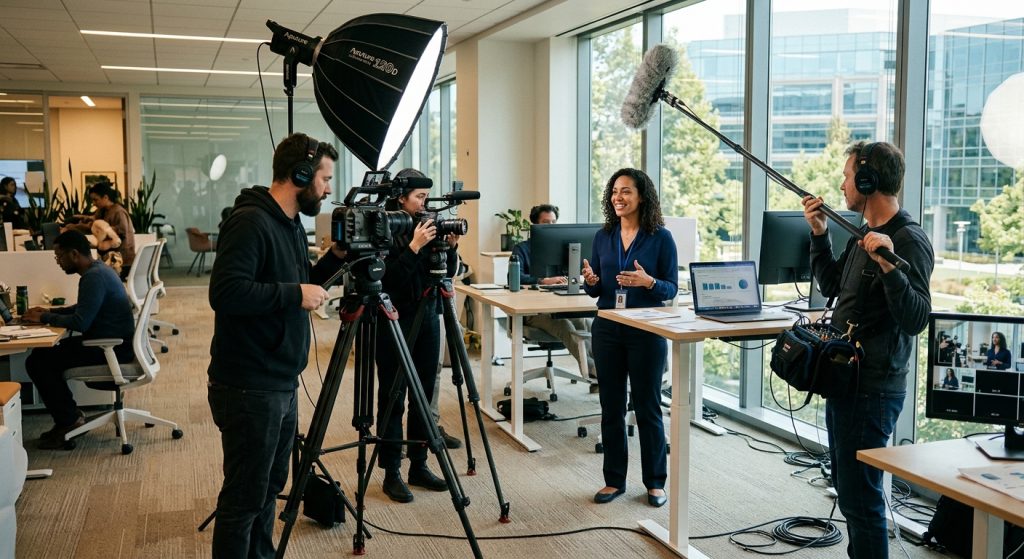
Start with the role, not the brand. Pick the position that’s hardest to fill and decide what the ideal applicant needs to believe after watching. Then choose 3-5 employees at different levels, including at least one person who’s been there a few years and one who joined recently. Ask open questions (“what surprised you in your first month?”) and let them answer in their own words. Our approach to corporate interview video leans on two cameras, lavalier mics and soft window light, because clean audio matters more than a fancy lens. If someone stumbles, we keep the stumble. It’s often the best line.
Cover the interview with real work
B-roll does the persuading. Film hands on keyboards, benches, patients, forklifts, whiteboard debates, lunch. Clear anything confidential off the walls first; in a Silicon Valley office that means product roadmaps on the whiteboard more often than you’d think. Get written releases from everyone on camera and have HR or legal look at the cut before it goes live.
Design for silent viewing
Caption everything, put the person’s name and role on screen, and make sure the first three seconds show a face or an action, not a logo animation.
Where should you publish a recruitment video?
Put it on your career page above the job description, then on LinkedIn, in your applicant tracking system, and on YouTube with a title that names the role and city. One shoot should feed all of them.
Pin the testimonial to the top of the relevant job post. Post the vertical cut on Instagram and TikTok, run the strongest 30 seconds as a targeted LinkedIn ad, drop the link into recruiter outreach emails, and ask employees to share it. The full playbook for distributing video content applies here, with one hiring-specific twist: link each video to the exact role, not a generic careers page.
How do you measure whether a recruitment video is working?
Track completion rate, click-through to apply, application volume, the share of applicants who advance to interview, and time-to-hire. Compare each against the same roles before the video went live.
A 60-90 second video with a completion rate above roughly 50% is doing its job. Application volume tells you about reach; the interview-advancement rate tells you about fit, and fit is where a recruitment video earns its money. Record a baseline for the role, publish, and check again at 30 and 90 days. More on setting this up in our post on measuring video marketing success.
Why a recruitment video matters for San Jose employers
In San Jose, candidates often hold two or three offers at once, so your video has to answer the question the job description can’t: what is it actually like here? That favors specific, honest footage over slogans.
Engineers, technicians and healthcare staff in the South Bay are used to slick employer pitches, and they tune them out. What cuts through is a real engineer showing the lab bench, or a shift lead explaining how the team covers for each other. If you want that made properly, our San Jose corporate video production team handles the whole thing from role selection to captioned cutdowns. My advice is to pick one role you’ve been trying to fill for months, shoot that first, and let the results decide what you film next.
Frequently Asked Questions
How long should a recruitment video be?
A recruitment video should run 30-60 seconds for social media, 60-90 seconds for an employee testimonial on a career page, and up to about 3 minutes for a day-in-the-life. Videos longer than five minutes lose most viewers, so cut anything that doesn’t help a candidate picture the job.
How much does a recruitment video cost?
A professionally produced recruitment video for a single role typically costs $3,000-$8,500. A multi-role culture package runs $8,000-$25,000, and a full campaign can exceed $40,000. DIY videos cost $200-$2,000, mostly for equipment. Shoot days, crew size, interview count, and number of versions drive the price most.
What should be in a recruitment video?
A recruitment video should show real employees describing their actual work, footage of the workspace and daily tasks, and a clear picture of who thrives in the role. Add captions, on-screen names and titles, and a direct link to apply. Skip generic slogans and stock footage, which candidates recognize immediately.
Do recruitment videos increase job applications?
Yes. CareerBuilder data cited in a 2024 SearchWorks analysis found job postings with video received a 34% higher application rate than postings without one. Results depend on video quality and placement, so track application volume and interview advancement for each role against its pre-video baseline.
Where should a company post its recruitment video?
A company should post its recruitment video on its career page above the job description, on LinkedIn, and in its applicant tracking system. Vertical 15-30 second cuts work on Instagram and TikTok, and a full version on YouTube helps search visibility. Link each video to its specific role.
