
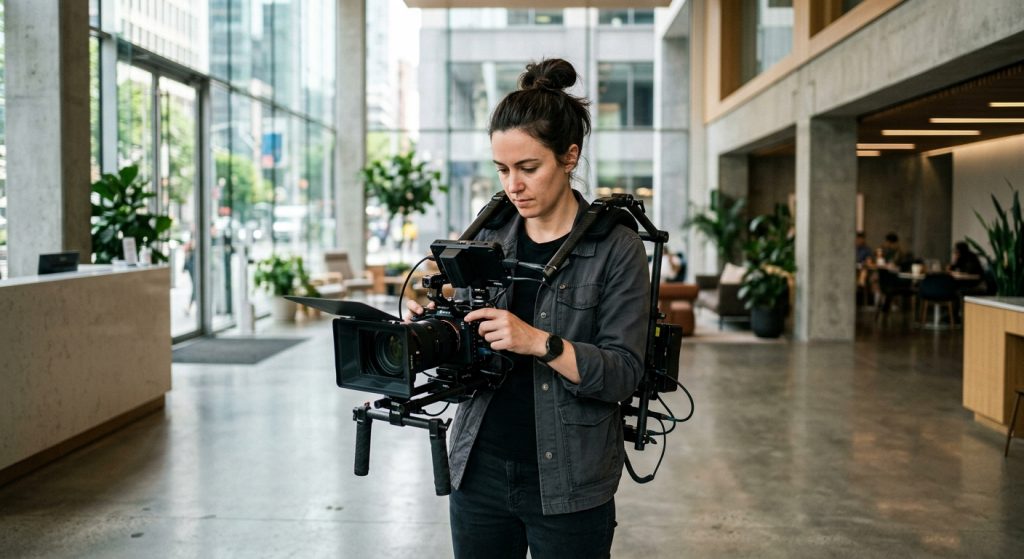
A restaurant client called us last spring after a freelancer she’d hired for a launch video got a stomach flu the morning of the shoot. No backup camera operator, no second shooter, no plan B — just a text message and a rebooked date that pushed her opening promo past the actual opening. That’s not a freelancer problem exactly. It’s a structure problem, and it’s the real question underneath “video production company vs freelancer”: are you buying a person, or are you buying a system that doesn’t fall apart if one person has a bad week?
Both options can produce great footage. I’ve hired freelance shooters who outwork some agency crews I’ve worked alongside. But the decision isn’t really about talent — it’s about what happens when the project gets complicated, when a client wants three cutdowns instead of one, or when the shoot day runs long and someone needs to make a call on the spot without waiting for a reply.
Video production company vs freelancer: what you’re actually comparing
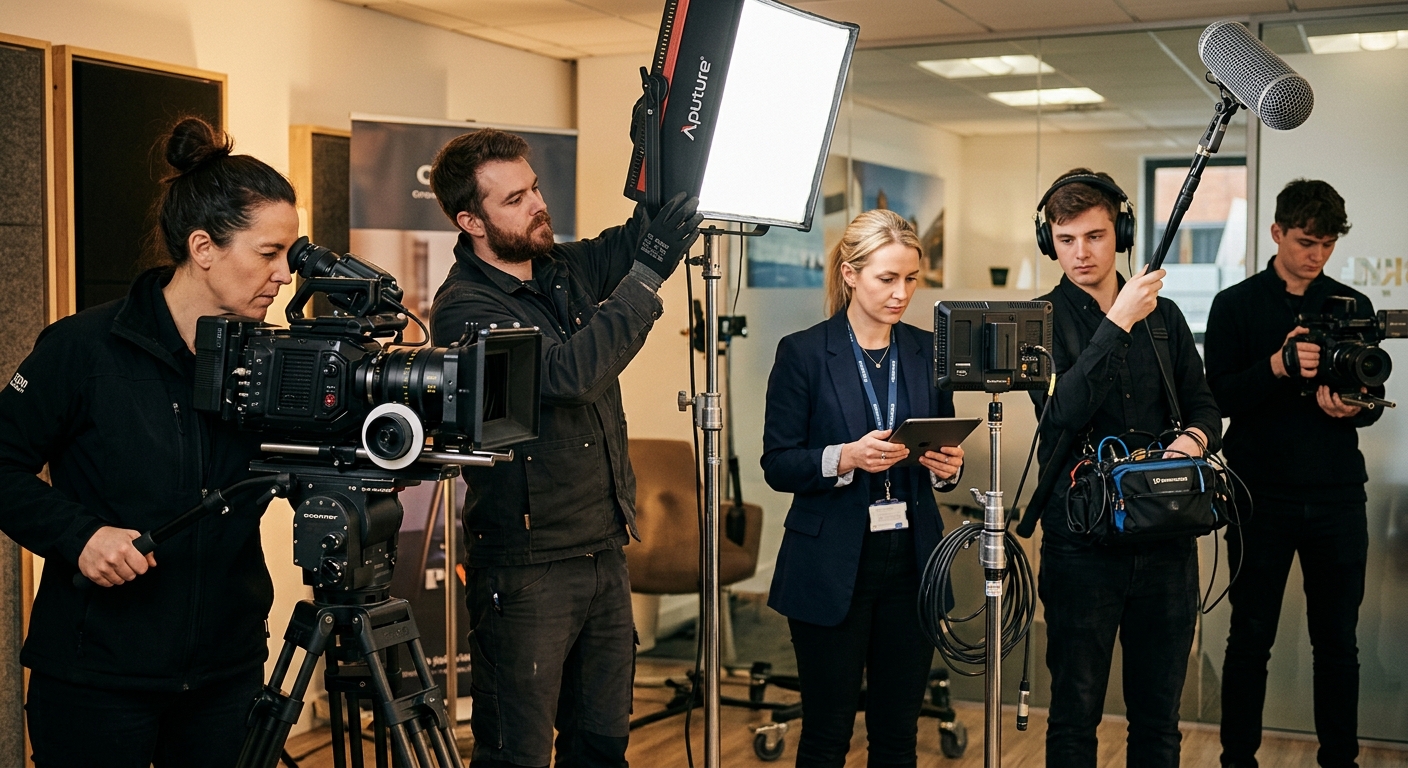
A freelancer is one person, sometimes two, wearing every hat — camera operator, audio, and often editor. You’re paying for their specific skill set and their calendar. A production company is a team with defined roles: a producer managing logistics, a director of photography running camera, someone dedicated to sound, and an editor who wasn’t standing in the sun for eight hours and can look at the footage with fresh eyes. If you want a deeper breakdown of everything that team actually does day to day, this rundown of what a video production company does is worth a look before you start getting quotes.
The distinction matters most when the project has moving parts. A single testimonial video with one subject in one location? A skilled freelancer handles that fine. A campaign with five locations, a talent release process, motion graphics, and three delivery formats for different platforms? That’s a coordination problem as much as a filming problem, and coordination is what a team is built for.
Day rates versus project minimums
Here’s where a lot of business owners get surprised. Freelancers in most markets charge somewhere between $600 and $1,200 per filming day, with editing billed separately at $60 to $150 an hour. That sounds cheap next to a production company’s typical project minimum of $5,000 to $15,000. But run the math on a real project. A two-minute brand video with a freelancer — one shoot day, ten hours of editing at $100/hour, plus a couple rounds of revisions — lands somewhere around $2,500 to $4,500 once you add it all up. A production company quoting $6,000 for the same deliverable is including a producer to manage the timeline, a second shooter for coverage, licensed music, motion graphics, and color correction as part of that number, not as line items you discover later.
The freelancer route isn’t dishonest pricing — it’s just unbundled. You’re the one assembling the team, which is fine if you know what you’re doing and have time to manage it.
Where freelancers actually make sense
I’ll say this plainly because too many agency sites won’t: hire a freelancer when the project is small, the brief is tight, and you don’t need a creative partner — you need a capable operator. Event coverage, a single interview for internal use, quick social clips, b-roll top-ups for a library you already have. A good freelancer with the right gear will get you clean, usable footage for less money and less process than bringing in a full crew.
Freelancers also move faster on scheduling. No layers of approval, no producer coordinating four calendars — you text them, they show up. If your business needs a steady stream of low-stakes content and you’ve found someone reliable, that relationship can genuinely outperform hiring an agency for the same volume.
Where a production company earns its rate
The gap shows up on anything with actual business risk attached — a product launch, an investor pitch, a campaign running across TV and paid social where a shaky edit costs you money in ad spend, not just embarrassment. That’s when project management, backup equipment, and a team that can absorb a problem without stopping the shoot start paying for themselves.
It also shows up in liability. Production companies typically carry general liability insurance and can provide certificates of insurance, which most venues, corporate offices, and event spaces require before they’ll let a crew on site. Plenty of freelancers don’t carry this, and finding out on shoot morning that your location won’t let the crew in is a bad way to start a production day.
And it shows up in scale. If this is the first of several videos — onboarding content, recruiting, quarterly campaigns — a production company builds a visual language once and repeats it, so your fifth video looks like it belongs with your first. Piecing that together across five different freelancers, each with their own color style and gear, is how brands end up with a content library that looks like five different companies made it. We cover a lot of this same territory in 5 benefits of hiring a professional videographer for your business, if you want the case for going pro laid out project by project.
The hidden costs nobody quotes upfront
Ask any production veteran and they’ll tell you the quoted rate is rarely the final cost — on either side of this comparison. With freelancers, watch for: reshoot fees if the first pass doesn’t work, per-revision charges that weren’t mentioned at booking, and rush fees if your timeline shrinks. With production companies, watch for: scope creep on “just one more shot,” licensing fees for stock music or footage stacked on top of the base quote, and change-order costs if you approve a script and then rewrite it mid-shoot.
The fix for both is the same — get a real brief nailed down before anyone picks up a camera. We put together a guide on building an effective video brief that walks through exactly what to lock in ahead of time so the quote you get is the number you actually pay.
How to decide for your next project

Ask yourself three questions. First, does this video carry real business risk if it underperforms or looks unpolished — investor materials, a paid ad campaign, anything tied to revenue? Lean production company. Second, is this a one-off, low-stakes piece where “good enough and fast” beats “polished and coordinated”? Freelancer is probably fine. Third, will you need more videos like this one within the next year? If yes, the consistency a production company builds in usually outweighs the per-project savings of a freelancer, because you’re not starting from zero every time.
A lot of businesses land on a hybrid: a production company for the flagship pieces — brand films, launch videos, anything client-facing at scale — and a trusted freelancer for the routine stuff in between. That’s not indecision, it’s just matching the tool to the job. If you’re weighing this for a specific shoot and want a second opinion before you book anyone, our video production services page breaks down what a full crew actually includes, and our tips for hiring a reliable production company covers the questions worth asking before you sign anything, freelancer or otherwise.
We shoot both ends of this spectrum out of our San Diego video production studio — quick single-shooter projects for clients who just need clean footage fast, and full crews for campaigns where the stakes are higher. The honest answer for most business owners isn’t “always hire a company” or “always hire a freelancer.” It’s knowing which project you’re actually looking at before you start collecting quotes.
