
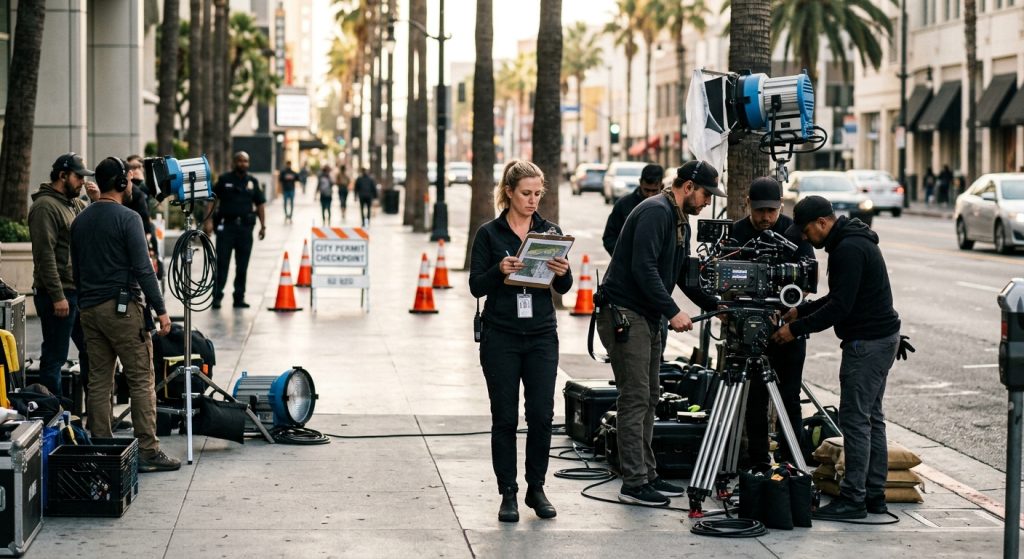
You’ve got the client’s shot list locked, half the crew confirmed, and a hero location everyone loves. Two days before the shoot, someone finally asks: “Did we pull a permit for this?” On a studio job, nobody would care. On a public sidewalk, beach, or park, that question — asked too late — can shut down a $30,000 production day before anyone’s flipped on a light, which is exactly why knowing how to get a film permit matters more than most producers admit until the day it bites them.
The process isn’t complicated once you’ve done it a few times, but it trips up first-timers constantly because rules differ by jurisdiction and deadlines sneak up fast. Here’s how it actually works, what it costs, and where people get burned.
What a Film Permit Actually Covers
A film permit is written authorization from a city, county, park district, or other public agency to use a specific public location for filming on a specific date. It’s not a formality — it’s the document that lets you legally close a sidewalk lane, park a grip truck in a loading zone, or set up lights in a public park without a passerby or a beat cop having grounds to end your day early.
Permits typically cover the location, the dates and hours, the equipment you’re bringing (tripods, dollies, lighting rigs, generators), and any special activity like drone use, street closures, or simulated weapons. Shooting entirely inside a private studio or on private property you’ve secured through a location release usually doesn’t require a government permit at all — but the moment your crew, gear, or vehicles spill onto a public sidewalk, alley, or shared lot, that portion of the shoot falls under normal permit rules.
How to Get a Film Permit, Step by Step
Getting a film permit comes down to five steps: scout and confirm your locations, line up insurance, submit the application to the right office, pay any fees, and complete community notification if required. The order matters — insurance and location confirmation have to happen before most offices will even accept your paperwork.
1. Lock your locations first. Before you apply for anything, confirm exactly where cameras, crew, vehicles, lighting, and basecamp will sit. A beach, city park, county park, port property, trolley station, or private lot can each fall under a different office with different rules, so “we’re filming at the pier” isn’t specific enough to start a permit application. Permit research belongs in the earliest steps of pre-production planning, right alongside scouting and budgeting, not something you bolt on the week before the shoot.
2. Secure your insurance. You’ll need a Certificate of Insurance before most agencies will release a permit — see the section below for specifics.
3. Submit your application. Most cities now run this through an online portal. You’ll list dates, locations, equipment, headcount, and any special activity (pyrotechnics, weapons, drones, water work) that triggers extra review.
4. Pay the fees and get your permit in hand. Some jurisdictions don’t charge anything for standard filming on public property; others charge per day, per location, or per activity. Keep the actual permit document accessible on set — a location manager or city inspector can ask to see it.
5. Handle outreach if it’s required. Busier jurisdictions often require a “notice of filming” or good-neighbor notification delivered to nearby residents and businesses a couple of days before you shoot, especially for anything involving noise, lighting rigs overnight, or parking impact.
This whole process is one of the less glamorous parts of a producer’s role on and off set — it’s paperwork, not creative work, but a missed step here can cost you the entire shoot day. If your team doesn’t have someone who does this regularly, it’s worth folding permit-pulling into the production services you’re already hiring a company for, rather than assigning it to whoever has spare time that week.
Insurance: The Part That Trips Up First-Time Producers

You need a Certificate of Insurance naming the permitting agency as additionally insured before almost any film permit gets released, and skipping this step is the single most common reason applications stall. Most cities want general liability coverage of at least $1 million per occurrence and $1 million aggregate, with the city, county, or agency listed on an Additional Insured Endorsement — a separate document from the certificate itself that many first-timers forget to request from their broker.
Workers’ compensation is required in California regardless of crew size, and it can’t be waived even if you’re the only paid person on set. If you’re bringing production vehicles, add auto liability. Some locations — airports, harbors, school properties — bump the required coverage up to $2 million or more. If you don’t already carry a production insurance policy, day-rate production insurance through a broker that works with filmmakers is usually faster than trying to get a one-off policy bound in 48 hours.
What Film Permits Cost (and Where They’re Free)
Film permit costs range from $0 for standard shoots on public property in San Diego to $931 for a motion photography application through FilmLA in Los Angeles, with most mid-size cities landing somewhere between $40 and $250 per day. There’s no national standard, so the cost of “getting a permit” really means the cost of getting a permit in that specific city.
A few real numbers to calibrate against: Chicago charges $250 per day per location for commercial productions (student and independent films can qualify for a reduced $25 rate with verification). Orange, California charges a $40 application fee plus $208 to $444 per day depending on the district. Salt Lake City runs about $142 for up to three locations. New York City doesn’t charge for the permit itself, but the real cost shows up in required police details, traffic control, and parking arrangements. San Diego, by contrast, charges no registration fee at all for filming or still photography on city public property, parks, beaches, or piers — one of the more production-friendly fee structures in the state.
Whatever the fee schedule looks like, build permit costs, insurance riders, and any required monitor fees into your production budget before you submit anything — these numbers rarely show up in a client’s initial estimate, and they’re not optional line items once a location is locked.
Permit Timelines: How Far Ahead to Apply
Most standard film permits take 3 to 5 business days to process, but shoots involving street closures, weapons, drones, pyrotechnics, or water work typically need 1 to 2 weeks of lead time, and some jurisdictions require months of notice for large-scale productions. San Diego, for example, asks for a 3-business-day minimum for standard shoots, a full week for street closures or drone (UAS) work, and two weeks for pyrotechnics, smoke effects, or beach vehicle use. Los Angeles caps standard processing at three business days through FilmLA but strongly recommends applying earlier if your shoot needs a rider, a monitor, or any special equipment review.
The mistake producers make isn’t misunderstanding the timeline — it’s not knowing the timeline exists until they’re already inside it. Treat permit lead time the same way you’d treat a casting deadline or a gear rental window: something you plan a video shoot around from day one, not something you check on after the location is already booked with the client.
For perspective: greater Los Angeles logged just 19,694 on-location shoot days in 2025, down 16.1% from 23,480 in 2024, according to FilmLA’s year-end production report. Even in the country’s largest permitting market, production volume is down and offices are watching applications more closely, which makes clean paperwork matter more, not less.
Filming in San Diego: What Makes It Different

Filming in San Diego is genuinely more producer-friendly than most major markets because the city charges no registration fee for standard shoots on public property, but jurisdiction still splits across several different offices depending on where you’re setting up. A beach, a city park, a county park, Port of San Diego property, an airport terminal, and a trolley station can each answer to a different agency, so “we’re shooting near the water” isn’t enough information to know who to call.
Start by contacting the San Diego Film Office directly at 619-685-1340 or [email protected] before you apply — they’ll tell you which office actually governs your location and flag anything unusual about the site. If your production touches pyrotechnics or open flame, you’ll need a separate permit from the Fire Prevention Department on top of the standard filming authorization. Drone shoots require a UAS Filming Checklist reviewed case by case. And student filmmakers get fee-free authorization with dedicated staff support, which is worth knowing if you’re working with a local film school on a spec spot.
If you’re producing commercial work anywhere in the region, it’s worth understanding how San Diego video production logistics differ from LA or the Bay Area before you commit to a location — the permit process is friendlier here, but the multi-agency structure catches people who assume “no fee” means “no paperwork.”
Common Mistakes That Get Permits Rejected (or Shoots Shut Down)
The permit mistakes that actually cost productions time are almost always about sequencing, not paperwork complexity: applying without insurance already in hand, assuming a private-property shoot needs zero permits when part of it touches a public sidewalk, and underestimating lead time for anything involving drones, weapons, or effects. A location release agreement from a property owner covers your right to be there creatively, but it doesn’t cover the sidewalk your grip truck is parked on, and city inspectors don’t accept private agreements as a substitute for public permits.
The other recurring failure is treating the film monitor or city inspector as an obstacle instead of a resource. Most jurisdictions that require an on-set monitor use that person to mediate real-time issues before they escalate into a shut-down, and producers who loop them in early get more flexibility than producers who try to work around them.
Frequently Asked Questions
How much does a film permit cost?
Film permit costs range from $0 in cities like San Diego, which offers fee-free permitting on public property, to $931 for a Los Angeles motion photography application through FilmLA. Mid-size cities often land between $40 and $250 per day, sometimes with added fees for street closures, parks, or after-hours riders.
How long does it take to get a film permit?
Most standard film permits take 3 to 5 business days to process, though shoots involving street closures, weapons, drones, or pyrotechnics can require 1 to 2 weeks of lead time. Los Angeles caps standard processing at three business days but recommends applying earlier for anything needing special review.
Do I need a permit to film with a small crew or one camera?
Yes, in most cities — permit requirements are based on location and equipment rather than crew size, so even a two-person crew with a tripod on a public sidewalk can need authorization. Purely handheld shooting on public property with no gear setup is sometimes exempt, but confirm your specific city’s rules before assuming you’re covered.
What insurance do I need for a film permit?
Most film permits require a Certificate of Insurance showing general liability coverage of at least $1 million per occurrence, with the issuing city or agency named as additionally insured. Many jurisdictions also require workers’ compensation, even for productions with just one or two paid crew members, plus auto liability if production vehicles are involved.
Can I film on private property without a permit?
You generally don’t need a government film permit to shoot on private property, but you do need a signed location release from the property owner, and some cities still require notification if the shoot affects public parking, noise, or street access. If any part of the shoot spills onto a public sidewalk, alley, or shared lot, that portion is still subject to normal permit rules.
